



The Wonderful Net: How Great White Sharks Solved a Problem That Stumped Fish Evolution for 400 Million Years
30 June 2026 | White Shark Ocean
Almost every fish on the planet is cold-blooded. This is not a design flaw. It is a sensible, energy-efficient solution to life in water: let the ocean regulate your body temperature, pay almost nothing in metabolic overhead, and get on with the business of surviving. For 400 million years, fish have been extraordinarily successful with this arrangement.
Great white sharks decided on a different approach. Not fully warm-blooded — maintaining a constant body temperature in all conditions, as mammals do, would be impossibly expensive in an animal this size. But not cold-blooded either. Instead, the great white evolved a structure so elegant and so effective that the Romans, when they eventually described it, could only call it rete mirabile — the wonderful net.
Understanding how it works changes everything about how you see a great white shark move through water.

The Problem with Being Cold-Blooded in Cold Water
Cold-blooded animals are slaves to their environment. When water temperature drops, their muscles slow down, their nerves conduct signals more sluggishly, their digestion stalls, and their reaction times increase. A cold-blooded shark hunting in 12°C water is a slower, less sensitive, less powerful version of itself than the same shark in 20°C water.
For an ambush predator that spends its life in a relatively warm, shallow coastal zone, this might be manageable. But great white sharks range across thousands of miles of open ocean, dive into cold deep water, and hunt prey — fast-moving seals, dolphins, tuna — that requires explosive acceleration and precise sensory processing. Cold muscles and sluggish nerves are not compatible with this lifestyle.
The solution the great white evolved is not to generate constant whole-body warmth — it is to trap and redirect the heat its own body already produces.
How the Rete Mirabile Works
Every moving muscle generates heat as a byproduct of contraction. In a cold-blooded fish, this heat is carried away by the blood, passed through the gills, and lost to the surrounding water. The fish warms up slightly when swimming hard, then immediately returns to ambient temperature.
In a great white shark, the blood does not take the heat to the gills. It is intercepted first.
The rete mirabile is a dense, interwoven mesh of tiny arteries and veins running in opposite directions, positioned between the gills and the shark's core. Cold, oxygenated arterial blood flows inward from the gills toward the muscles. Warm, deoxygenated venous blood flows outward from the muscles toward the gills. The two streams pass within fractions of a millimetre of each other, and because heat always moves from warm to cold, the heat in the venous blood transfers across to the arterial blood — before the arterial blood ever reaches the core.
The result is a closed loop: heat generated by muscle contraction is captured before it can escape, transferred to the incoming blood, and cycled back to the muscles and organs that produced it. The gills receive blood that has already been stripped of most of its heat. The ocean never gets it.
The great white does not generate warmth like a mammal does. It recycles warmth that would otherwise be wasted. The distinction matters, because it means the system is extraordinarily energy-efficient — the shark gets the thermal benefit without paying the full metabolic cost of true endothermy.
What Gets Warmed, and by How Much
The great white does not have a single rete mirabile. It has several, each dedicated to warming a different part of the body.
The largest supplies the red swimming muscles — the slow-twitch muscle fibres used for sustained cruising. In water at 12°C, a great white's red muscle runs at between 22 and 26°C: up to 14 degrees above ambient. This is not a small advantage. A muscle operating at 26°C contracts faster, produces more power, and recovers more quickly than the same muscle at 12°C. The shark is running a significantly more powerful engine than the water temperature would suggest is possible.
A separate rete system warms the brain and eyes. The eyes of a great white are not just passive sensors — they are processing visual information continuously, tracking fast-moving prey, calculating trajectories, and triggering precisely timed strikes. A warm eye processes information faster than a cold one. The great white's visual system operates at elevated temperatures even in frigid water, giving it sensory processing speeds that cold-blooded predators in the same environment cannot match.
A third system warms the stomach and viscera. Stomach temperatures in great white sharks have been measured at up to 17°C above the surrounding water — sometimes reaching 26 to 30°C in water that is barely above 12°C. This is metabolically critical: digestion is a chemical process, and chemical processes accelerate with heat. A great white that consumes a large meal in cold water can digest it at the speed of an animal living in warm water. The energetic return on each hunt is significantly higher than it would be in a cold-bodied predator.
Only Five Sharks in the World Do This
The rete mirabile system is not common. Of the more than 500 species of shark alive today, only five have independently evolved the capacity for this kind of regional endothermy. All five belong to the family Lamnidae: the great white (Carcharodon carcharias), the shortfin mako (Isurus oxyrinchus), the longfin mako (Isurus paucus), the porbeagle (Lamna nasus), and the salmon shark (Lamna ditropis).
This group is not merely related — they represent a distinct evolutionary lineage that solved a thermal engineering problem no other shark lineage managed to crack. They also share other characteristics: fast, open-ocean predators with crescent-shaped tails, high-aspect-ratio pectoral fins, and body plans optimised for sustained speed and long-distance travel. The rete mirabile is both cause and consequence of this lifestyle. It enables the performance that open-ocean hunting requires, and the open-ocean lifestyle creates the evolutionary pressure to develop it.
Notably, tuna evolved a nearly identical solution entirely independently. The two lineages — lamnid sharks and tunas — diverged from a common cold-blooded ancestor more than 450 million years ago. They arrived at the same answer to the same problem through completely separate evolutionary paths. In biology, this is called convergent evolution, and it is one of the strongest possible signals that a design is genuinely optimal: when evolution finds the same solution twice, from completely different starting points, across hundreds of millions of years, it is telling you something important about the physics of the problem.
Not Warm-Blooded. Better.
It is tempting to describe great white sharks as "warm-blooded" for simplicity, and this shorthand appears frequently in popular accounts. The reality is more interesting.
True warm-bloodedness — the kind mammals and birds have — means maintaining a constant core body temperature regardless of external conditions, through continuous heat generation from metabolic processes. It is extraordinarily expensive, requiring a constant supply of calories just to stay warm. A mammal of equivalent size to a great white shark would need to eat almost continuously to maintain its body temperature.
The great white's system sidesteps this cost. Rather than generating heat and fighting to keep it, it generates heat through normal muscle activity and captures it before it can escape. The metabolic overhead is far lower than true endothermy. The thermal benefit — warmer muscles, sharper eyes, faster brain, more efficient digestion — is substantially the same.
The technical term is regional endothermy or mesothermy: not fully warm-blooded, not cold-blooded, but something more precisely engineered than either. The great white is not an approximation of a mammal. It is a more elegant solution to the same underlying problem.
Why This Matters at Mossel Bay
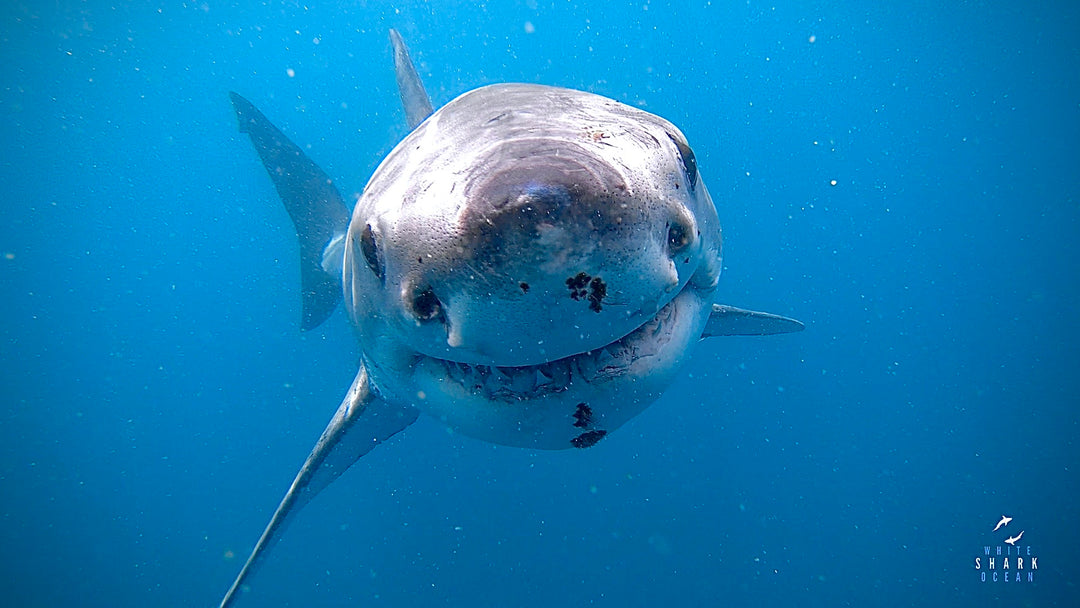
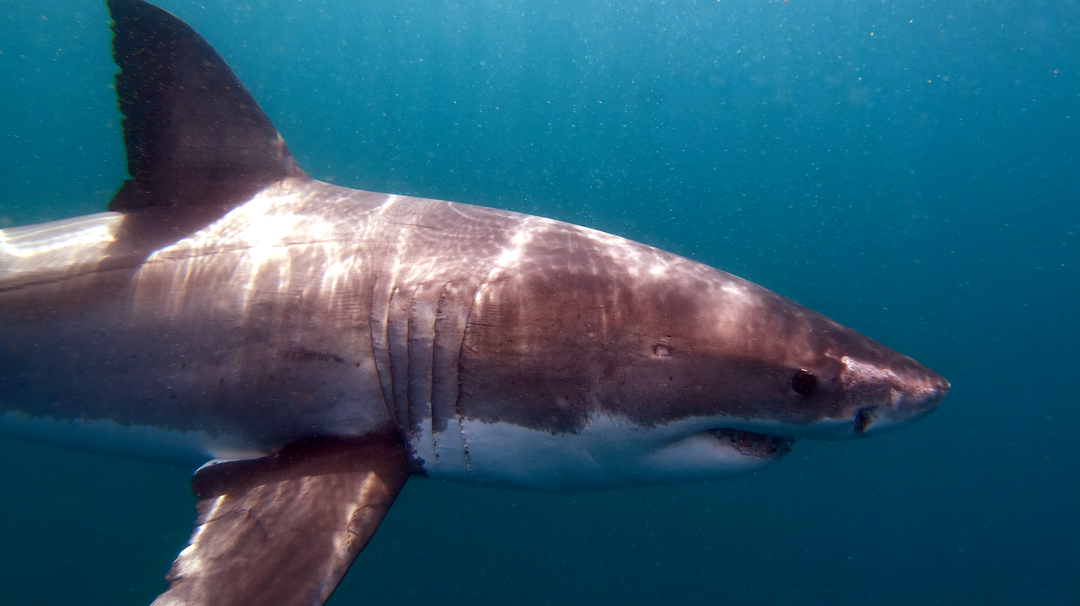
The next time a great white shark moves past the cage at Mossel Bay, the rete mirabile is running. The muscles driving that movement are 10 to 14 degrees warmer than the water surrounding them. The eyes tracking the cage are processing visual information at a speed that cold-blooded animals in the same water cannot approach. The biology is not just remarkable in the abstract — it is visible in the precision, the power and the apparent effortlessness of every movement.
This is what 400 million years of refinement looks like in practice. A system so efficient that only five species of shark ever evolved it, so effective that tuna independently arrived at the same solution half a billion years later, and so precisely calibrated that it still outperforms anything human engineering has managed to produce in its place.
White Shark Ocean operates cage diving and surface encounters in Mossel Bay — one of the few remaining places where you can see this biology in action. Book at whitesharkocean.com.
Frequently Asked Questions
Are great white sharks warm-blooded?
Not in the way mammals are, but they are far from cold-blooded. Great white sharks possess a biological structure called the rete mirabile — a dense mesh of interwoven arteries and veins — that captures heat generated by muscle contraction and recycles it back to the muscles, brain, eyes, and stomach, rather than losing it to the surrounding water. This makes them regionally endothermic or "mesothermic": specific parts of their body run significantly warmer than the surrounding ocean. Only five shark species in the world have evolved this system, all in the family Lamnidae.
What is the rete mirabile in great white sharks?
The rete mirabile (Latin for "wonderful net") is a network of tiny arteries and veins running in opposite directions, positioned between the gills and the shark's core muscles. Cold arterial blood flows inward from the gills while warm venous blood flows outward from the muscles. The two streams pass close enough that heat transfers from the warm to the cold blood before the cold blood reaches the muscles. The heat stays in the system rather than being lost at the gills. The great white has multiple rete systems, each dedicated to warming different organs: swimming muscles, brain and eyes, and stomach.
How much warmer is a great white shark's body than the surrounding water?
It varies by body part. The red swimming muscles run at 10 to 14°C above the surrounding water temperature — so in 12°C water, the muscles may be operating at 22 to 26°C. Stomach temperatures have been measured at up to 17°C above ambient, sometimes reaching 26 to 30°C in cold coastal waters. The brain and eyes are also warmed via a separate rete system. In practical terms, a great white hunting in cold South African waters is running its core systems at the equivalent of a much warmer environment.
Why did great white sharks evolve to be partially warm-blooded?
Regional endothermy provides significant performance advantages for open-ocean predators: faster muscle contraction and greater power output, faster visual processing for tracking agile prey, faster nerve conduction, and more efficient digestion of large meals in cold water. These advantages are particularly valuable for animals that range across thousands of miles of ocean at varying temperatures and need to hunt fast, agile prey. The evolutionary pressure was strong enough that the system evolved independently in both lamnid sharks and tunas — two groups that diverged more than 450 million years ago — which is a strong signal that this solution is near-optimal for the problem it solves.
Which other sharks can regulate their body temperature?
Only five shark species have evolved the rete mirabile system for regional endothermy, all in the family Lamnidae: the great white shark, the shortfin mako, the longfin mako, the porbeagle, and the salmon shark. All five are fast, open-ocean predators with similar body plans optimised for sustained high-speed travel. No other shark families have developed this capability. Outside sharks, regional endothermy has evolved independently in several tuna species and billfishes, making it one of the most remarkable examples of convergent evolution in the animal kingdom.







Are great white sharks known to swim in freshwater
Are great white sharks known to swim in freshwater
Leave a comment