


The Ocean's Living Fossils: Shark Species That Time Forgot
16 July 2026 | White Shark Ocean
When palaeontologists talk about a living fossil, they mean an animal so similar to its ancient ancestors that looking at the living creature and looking at a fossil from tens of millions of years ago produces almost no meaningful difference. The body plan, the anatomy, the fundamental design — essentially unchanged while everything around them was transformed by time, extinction, and the slow pressure of evolution.
The ocean contains several of these animals, and a disproportionate number of them are sharks. While the land was remade repeatedly — by asteroid impacts, ice ages, the rise and fall of mountain ranges, the drift of continents — the deep ocean remained comparatively stable. And in that stability, certain shark lineages found conditions so well suited to what they already were that change offered no particular advantage. They stayed as they were. And they are still here.

The Frilled Shark: A Cretaceous Animal in Modern Waters
The frilled shark (Chlamydoselachus anguineus) looks, at first glance, less like a shark and more like something that should not still exist. Its body is long and eel-like, typically between 1.5 and 2 metres. Its mouth is at the very front of its head — a terminal position, rather than the underslung jaw of most modern sharks — and it is lined with approximately 300 trident-shaped teeth arranged in 25 rows. Its six pairs of gill slits are edged with frilled, reddish tissue that gives the animal its name. Photographs of it, when it has been filmed alive near the surface after being brought up accidentally in deep-sea trawls, tend to go viral precisely because it looks prehistoric in a way that most animals do not.
It is prehistoric. The family Chlamydoselachidae has a confirmed fossil record stretching back approximately 95 million years to the Cretaceous period — the era of the dinosaurs — and the living frilled shark is anatomically so close to those fossil specimens that it is genuinely difficult to identify meaningful differences. Its six gill slits, its terminal mouth, its body proportions and jaw articulation are all features that most shark lineages evolved away from hundreds of millions of years ago. The frilled shark retained them because it lives in a world that selected for them: deep water, between 200 and 1,500 metres, where it is thought to hunt soft-bodied prey like squid and small fish by bending its flexible body and striking like a snake.
So rarely is it seen alive that a second species — Chlamydoselachus africana, found off the southern African coast — was not formally described by science until 2009. There may be aspects of its behaviour and ecology that we still have no observations of at all.
The Goblin Shark: 125 Million Years of the Same Jaw
The goblin shark (Mitsukurina owstoni) is the only living member of the family Mitsukurinidae, a lineage approximately 125 million years old. Its appearance is extraordinary: a long, flat, paddle-like snout projecting well ahead of the rest of the head, beneath which sits a set of jaws that, when the shark attacks, slingshot forward with a speed and reach that has to be filmed at high frame rates to be understood. The teeth are long, narrow, and nail-like, designed for snagging slippery deep-sea fish and squid rather than the broad cutting of surface-hunting sharks.
The jaw protrusion mechanism is the goblin shark's most remarkable feature, and it is a genuinely ancient one. The ability to protrude the jaws — shared, in a different form, with the great white shark — has roots that stretch back through this lineage for over a hundred million years. What the goblin shark does is an extreme version: its jaws can extend so far forward that they project almost to the tip of the snout. High-speed footage shows the entire jaw assembly shooting forward and snapping shut in a fraction of a second, a hunting mechanism essentially unchanged since the Cretaceous.
Like the frilled shark, the goblin shark inhabits deep water — typically 270 metres and deeper, with some specimens recorded below 1,300 metres — and is rarely observed alive. Most of what we know about it has been pieced together from accidental catches in deep-sea fishing operations.
The Cow Sharks: The Original Design
If you want to understand what the first true sharks probably looked like, the hexanchiformes — the cow sharks — are the closest living approximation. Most modern shark orders have five gill slits. The hexanchiformes have six or seven, a feature shared with the earliest shark-like animals in the fossil record and retained in no other living shark order. Their body plan is considered primitive in the scientific sense: it represents an early, generalised design that the rest of shark evolution departed from, while this lineage stayed.
The broadnose sevengill shark (Notorynchus cepedianus), with its seven gill slits and comb-like lower teeth, has fossil relatives from the Jurassic period, over 150 million years ago. The bluntnose sixgill shark (Hexanchus griseus) has a similarly deep fossil record. Researchers who study these animals note that their anatomy is, as far as the incomplete fossil record allows us to judge, very close to how the first sharks were built. The hexanchiformes did not fail to evolve — they evolved into a form that worked so well in the deep ocean that further change offered no improvement.
The broadnose sevengill is particularly interesting because it is not exclusively a deep-water animal. It comes into shallow bays and kelp forests, making it one of the most observable of the ancient shark lineages. Watching a sevengill shark in a shallow bay is, in a meaningful sense, watching something close to what swam in Jurassic seas.
Why the Deep Ocean Is a Museum
The pattern across all these animals is consistent: they are deep-water species, or species with strong deep-water associations, and they are ancient. This is not a coincidence. The deep ocean is one of the most stable environments on earth. Temperature, pressure, and chemistry change slowly over geological time compared to the surface. The catastrophic events that drove mass extinctions — asteroid impacts, volcanic winters, ocean acidification — hit the surface world hardest. The deep remained comparatively buffered.
In every major extinction event, deep-water species showed higher survival rates than their shallow-water counterparts. The ancestors of the frilled shark, the goblin shark, and the cow sharks almost certainly retreated to or persisted in deep water during the moments when surface conditions became lethal. And in that deep stability, there was no pressure to change. The design that worked in the Cretaceous deep ocean still works in the deep ocean today, because the deep ocean has not changed enough to make it obsolete.
This makes the deep sea something that has no equivalent on land: a place where evolution has been allowed to preserve its earlier work, where animals that look like they belong in a natural history exhibit are alive and hunting in the dark.
What Living Fossils Tell Us
It is worth being precise about what "living fossil" means and does not mean. These animals are not frozen in time. They have continued to evolve over the millions of years since their ancestors' fossil forms were laid down — their genetics have changed, they have adapted to subtle shifts in their environment, and they are not simply photocopies of Cretaceous animals. What has remained stable is their body plan, their fundamental anatomy, and their ecological role. The fine-tuning has continued; the blueprint has not.
What they tell us is that the shark design — the cartilaginous skeleton, the electroreception, the replaceable teeth, the flexible jaw — is not just ancient. It is so well suited to its purpose that some versions of it have gone essentially unimproved for over a hundred million years. In a world where most evolutionary lineages are in constant flux, where adaptation and replacement happen on timescales of thousands to millions of years, the existence of animals this unchanged is a statement about how well the original design worked.
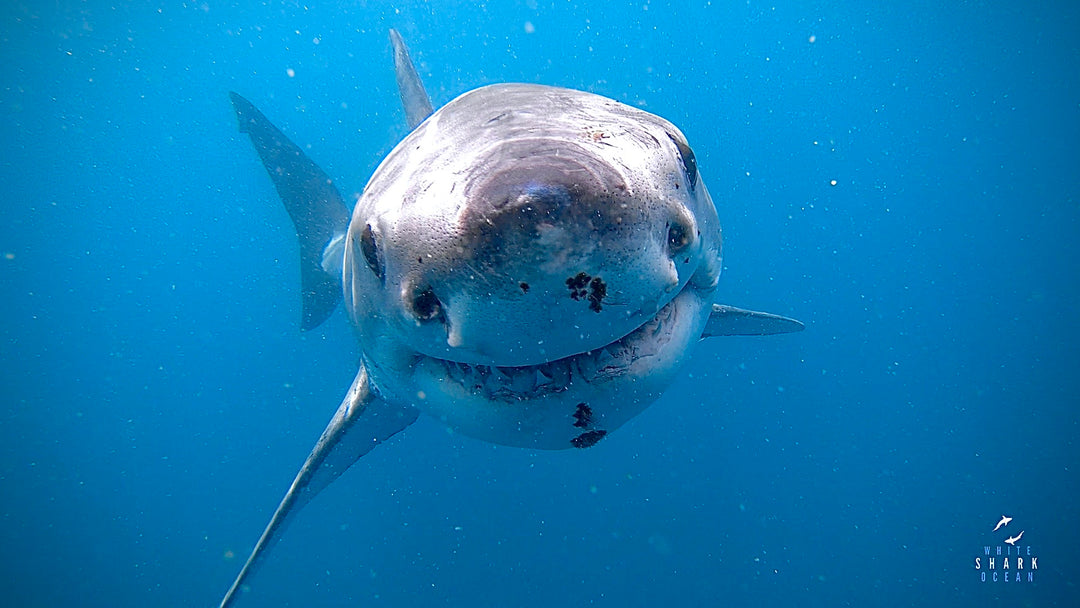
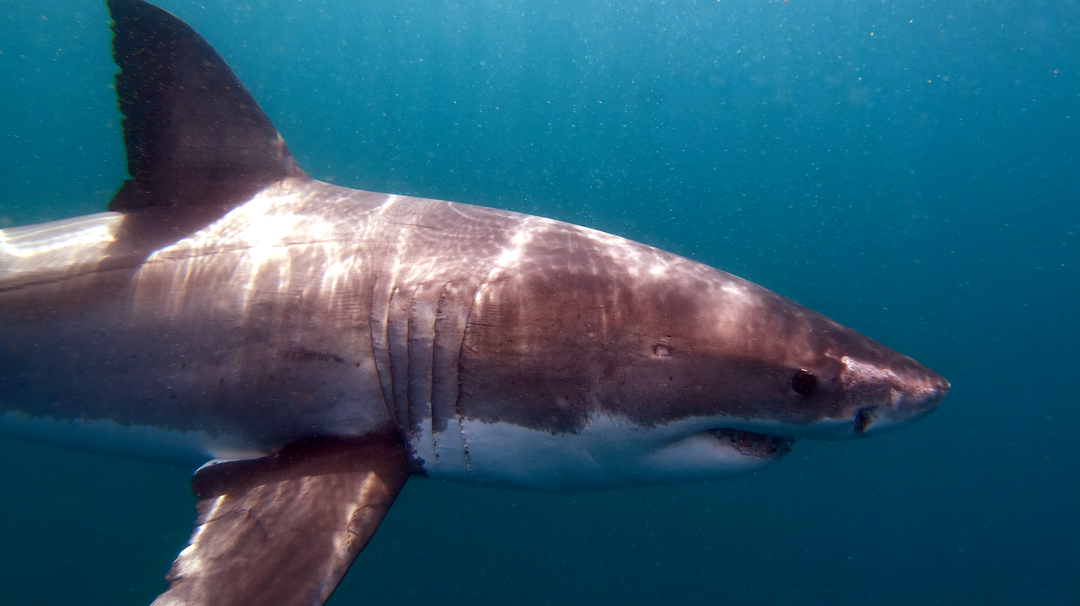
The great white shark in Mossel Bay shares its class, its cartilage, its teeth, and its electroreception with the frilled shark moving through the dark a kilometre below the surface. They are very different animals, the products of very different evolutionary paths over a very long time. But they are branches of the same ancient tree, and both of them have outlasted almost everything else that has ever lived.
White Shark Ocean operates cage diving and surface encounters with great white sharks in Mossel Bay, South Africa — one of the ocean's most remarkable surviving predators. Book at whitesharkocean.com.
Frequently Asked Questions
What is a living fossil?
A living fossil is an organism whose body plan and anatomy have remained largely unchanged over tens or hundreds of millions of years, while other lineages around it have diversified or gone extinct. The term does not mean the animal has stopped evolving entirely — its genetics and fine details have continued to change — but its fundamental design has remained stable enough that comparisons between the living animal and ancient fossil specimens reveal no major structural differences. Sharks contain a disproportionate number of living fossil species, primarily in deep-water lineages where environmental stability has reduced the pressure to change.
How old is the frilled shark lineage?
The family Chlamydoselachidae, which contains the frilled shark, has a confirmed fossil record stretching back approximately 95 million years to the Cretaceous period. The living frilled shark (Chlamydoselachus anguineus) is anatomically so close to those Cretaceous fossils that meaningful differences are difficult to identify. Its six gill slits, terminal mouth position, trident-shaped teeth, and eel-like body are all primitive features retained from an era when dinosaurs still walked on land. A second species, Chlamydoselachus africana, was only formally described by science in 2009.
Why do some shark species look so ancient?
Most of the shark species that look most ancient — frilled sharks, goblin sharks, cow sharks — live in deep water, and the deep ocean is one of the most stable environments on earth. The catastrophic events that drove mass extinctions affected surface environments most severely; deep water remained comparatively buffered. In that stable environment, a body plan that worked in the Cretaceous still works today, because the conditions it was adapted for have not changed enough to make it obsolete. Deep water acts as a museum, preserving evolutionary designs that the surface world long ago replaced.
Do goblin sharks still exist?
Yes. The goblin shark (Mitsukurina owstoni) is the only living member of its family, Mitsukurinidae, a lineage approximately 125 million years old. It lives in deep water, typically below 270 metres and sometimes below 1,300 metres, and is very rarely observed alive. Most knowledge of the goblin shark has been gathered from specimens accidentally caught in deep-sea fishing operations. Its most distinctive feature — a slingshot jaw mechanism that can project the entire jaw assembly forward at high speed — is documented in fossil relatives dating back to the Cretaceous.
What makes cow sharks different from other sharks?
Cow sharks belong to the order Hexanchiformes and are distinguished from virtually all other living sharks by having six or seven gill slits, rather than the five that characterise modern shark orders. This is considered a primitive feature — it matches the gill slit count seen in the earliest shark-like animals in the fossil record. Their body plan is regarded as the closest living approximation to the original shark design. Fossil relatives of the broadnose sevengill and bluntnose sixgill sharks are known from the Jurassic period, over 150 million years ago.





Leave a comment