


60 Minutes Just Asked the Question We've Been Living With for a Decade
23 June 2026 | White Shark Ocean
This Sunday, 60 Minutes correspondent Anderson Cooper asked a question that anyone who works on the water in South Africa has been asking for the better part of a decade.
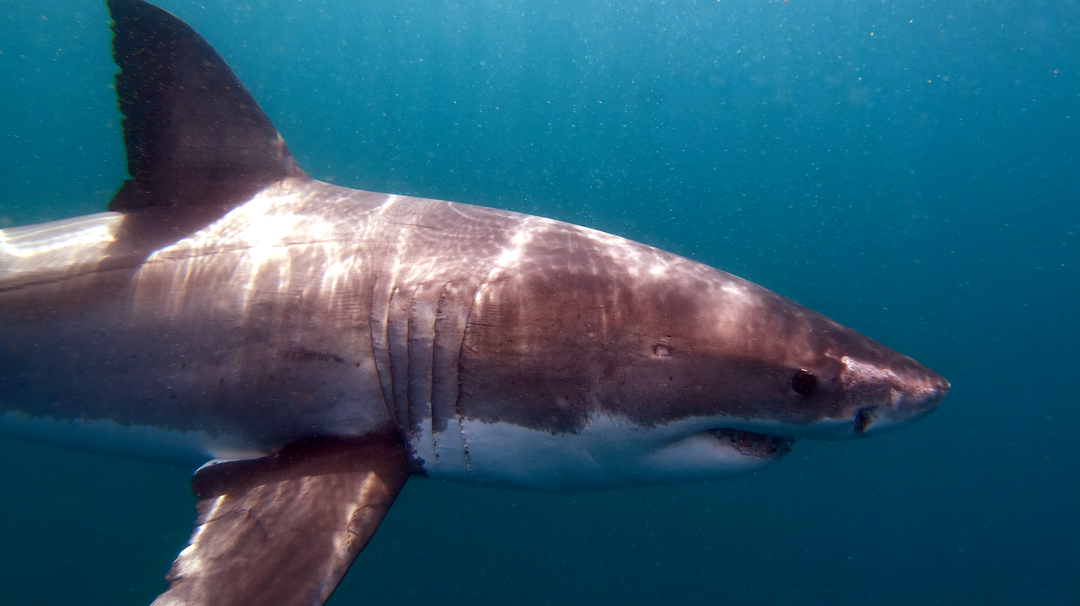
What happened to the great white sharks?
The episode, which aired on 21 June 2026, brought the mystery of South Africa's disappearing great white sharks to a global mainstream audience for the first time. It also laid bare something those of us on the ground have known for years: that the scientists and conservationists trying to save these animals cannot agree on the answer. And that disagreement, left unresolved, may cost us the sharks.

A Mystery That Began in 2015
The timeline is familiar to anyone who has followed this story closely. In 2015, marine biologist Alison Kock of South African National Parks started receiving photographs of smaller shark carcasses on the seafloor near Seal Island in False Bay. The incisions were so clean she initially assumed they'd been made with a knife.
Then, underwater, she found the culprit: a pair of orcas.
Port and Starboard — named for their distinctively collapsed dorsal fins — had developed a specialised and lethal technique. Working as a pair, they would incapacitate a great white shark and remove its liver with surgical precision: the most calorie-dense organ in the body, occupying nearly a third of the shark's total mass. By 2017, great white carcasses with the same characteristic incisions were washing ashore along the Western Cape.
The presence of these two orcas, researchers now believe, was enough to trigger a mass exodus. Great white sharks fled the area and — critically — did not return.
"They've become world famous, or infamous," said whale-watching operator David Hurwitz, who was the first to identify Port and Starboard on the water.
The Case for Orcas
Kock's position, as presented on 60 Minutes, is that the overall South African population of great white sharks remains broadly stable. The sharks haven't vanished — they've displaced. Driven by the orca threat and the scent of shark liver oil, they've moved further up the coast. Mossel Bay, Plettenberg Bay, and points east have seen more consistent activity as a result.
There is supporting evidence for this. Acoustic tagging data shows individual sharks that were once regular presences in False Bay now spending extended periods further north and east. And Port and Starboard's behaviour has evolved: scientists now believe the pair may be actively teaching other orcas their technique. In 2022, drone footage captured five orcas working cooperatively to kill a great white. Single orcas have since been documented hunting sharks both in South Africa and further afield.
For Kock, the priority is understanding and adapting to this new dynamic — not catastrophising it.
The Case for Human Culpability
Marine biologist Enrico Gennari, who has spent 20 years researching great white sharks in South Africa and directs the Oceans Research Institute, sees it differently. On 60 Minutes, he made the case that blaming orcas is too convenient — and dangerously distracting.
Gennari and wildlife photographer Chris Fallows, who once documented 250 to 300 great white sightings per year at Seal Island and now sees none, argue that the numbers began falling years before Port and Starboard appeared. The orcas, in their reading, are a precipitating factor in an already weakened population — not the root cause.
Their evidence points firmly at humans. Commercial longlining boats operate off the South African coast, laying miles of hooks that target smaller shark species: the same species great whites rely on as prey. Those sharks are caught, processed and exported — primarily used for cheap fish and chips in Australia. Meanwhile, shark nets and drum lines installed to protect swimmers have been killing more than 20 great white sharks per year since the 1950s.
"The devices are designed to kill and lower the population number," Gennari said on 60 Minutes. "The concept is one less shark, one less chance of an encounter with a human."
"If we lose the white shark in South Africa, we lose a battle for all nature," he added. "If we can't protect even the most charismatic, most protected species — on paper — in South Africa, what chance do the little guys, the other sharks or the other animals, have against unsustainable use?"
The Feud That Science Cannot Afford
The 60 Minutes segment doesn't resolve the debate. It exposes it — with remarkable candour from both sides. And from the perspective of those of us working daily in the waters these scientists are arguing about, the exposure is both welcome and deeply frustrating.
Fallows, who has dedicated his career to documenting and celebrating great white sharks, was perhaps the most direct voice of all.
"Let's stop bickering about something we can't control," he said, "and let's start focusing on the things that we can control. If we don't start addressing those factors that we can control, I don't believe there's any hope."
It is a position that is hard to argue with. The orcas are not going anywhere. Port and Starboard's behaviour is evolving, not retreating. But shark nets, longline fishing, drum lines — these are human decisions that can be unmade.
What It Looks Like from Mossel Bay
Here at White Shark Ocean, we operate in a stretch of water that has become more significant for great white sharks precisely because of the pressures described in that 60 Minutes episode. As False Bay has emptied, areas like Mossel Bay have taken on greater importance as refugia — places where sharks can still find prey, relative safety, and the conditions they need.
What we observe on the water every season aligns with Gennari's broader warning: these animals are present, but they are not invulnerable. Their numbers are not what they were. Their presence is not guaranteed from one season to the next. The ocean here is extraordinary. But it is not inexhaustible.
Fallows draws an analogy to humpback whale conservation — a species that was hunted almost to extinction and then, after a global moratorium on commercial whaling in the 1980s, began one of the most dramatic wildlife comebacks in recorded history. "What it's got, I believe, a hundred percent to do with is enlightened governments, passionate individuals, showcasing the whales for what they were: incredibly sentient creatures having an important role to play in our ocean," he said. "It's called balance. A balanced ocean is a healthy ocean."
That is the model. That is what is possible. South Africa was the first country in the world to give great white sharks full legal protection, back in 1991. The question now is whether that protection has enough teeth — and whether we are willing to extend it to the fishing practices, the gear types, and the coastal management decisions that determine whether the sharks actually survive.
60 Minutes asked the question. The answer is still being written. And it will be written here, on the water, by the decisions we make in the next few years.
Join us in Mossel Bay to see great white sharks in their natural habitat and be part of the conversation about their future. Book with White Shark Ocean at whitesharkocean.com.
Frequently Asked Questions
What did the 60 Minutes episode about great white sharks reveal?
The 60 Minutes episode that aired on 21 June 2026, reported by Anderson Cooper, investigated the mysterious disappearance of great white sharks from South Africa's coastal waters, particularly around False Bay near Cape Town. The segment exposed a bitter scientific feud between two camps: marine biologist Alison Kock, who attributes the disappearance primarily to predation by the orca pair Port and Starboard, and researcher Enrico Gennari and photographer Chris Fallows, who argue the decline began before the orcas arrived and is driven primarily by human activities including commercial longlining and shark nets.
Are great white sharks still in South Africa?
Yes — great white sharks are still present in South African waters, including in Mossel Bay, Plettenberg Bay and along the Garden Route. However, their distribution has shifted significantly from a decade ago. Areas like False Bay and Gansbaai, once the most reliable great white habitats in the world, now see very few sightings. Researchers debate whether this represents displacement (sharks moving elsewhere) or an underlying population decline. White Shark Ocean continues to operate great white shark encounters in Mossel Bay, where the sharks remain an active presence.
Who are Port and Starboard, the orcas that hunt great white sharks?
Port and Starboard are two male orcas first identified off Gansbaai, South Africa, in 2015. Named for their distinctively collapsed dorsal fins — one folded to the port (left) side, one to the starboard (right) — they became notorious for developing a highly specialised technique of killing great white sharks and extracting their livers. Unlike most orcas, which hunt in larger pods, Port and Starboard initially operated as a pair. Scientists now believe they may be teaching other orcas their technique, with cooperative group hunts increasingly documented. Their presence is widely considered a key factor in the exodus of great white sharks from False Bay.
Do shark nets actually kill great white sharks?
Yes. Shark nets and drum lines — the two technologies used to protect swimmers along South African beaches since the 1950s — kill marine animals indiscriminately, including great white sharks. Researchers including Enrico Gennari estimate that these devices kill more than 20 great white sharks per year in South African waters. Great white sharks have been fully protected by law in South Africa since 1991, making this mortality rate particularly difficult to justify. Non-lethal alternatives including magnetic deterrent fields and fine-mesh exclusion nets exist and are increasingly advocated for by conservation researchers.
Can great white shark populations recover like humpback whales did?
The humpback whale recovery is frequently cited as a model for great white shark conservation, and for good reason. Humpback whales were hunted to the edge of extinction; following a global moratorium on commercial whaling in the 1980s, their populations have rebounded dramatically worldwide. Shark populations can also recover given sufficient time and protection, but the process is slow — great whites reach sexual maturity at around 15 years of age and reproduce infrequently. The key parallel to whales is clear: meaningful recovery requires removing the human pressures that are driving the decline, not just protecting the species on paper. In South Africa, that means addressing longlining, shark nets, and bycatch mortality with the same seriousness that the whaling moratorium addressed commercial hunting.




Leave a comment