


The Secret Life of Baby Great White Sharks
15 July 2026 | White Shark Ocean
Nobody has ever seen a great white shark give birth. In all the years of research, cage diving, tagging, and observation around the world's great white hotspots — the Farallon Islands, Guadalupe, Gansbaai, Mossel Bay, Neptune Islands — no scientist or diver has ever witnessed the moment a great white pup enters the ocean for the first time. We have tagged adults, tracked their migrations, sequenced their genomes, and measured the electrical fields they produce. The birth itself remains unseen.
What we do know about the early lives of great white sharks has been assembled piece by piece, from juvenile specimens caught incidentally, from nursery area surveys, and from one extraordinary piece of footage captured in July 2024 off the coast of Santa Barbara, California — what researchers believe is the first video ever taken of a newborn great white shark in the wild.

Born Already Formidable
Great white sharks are viviparous — they give birth to live young rather than laying eggs. The gestation period is approximately 18 months, one of the longest of any shark species, and a litter typically contains between two and ten pups, though up to seventeen have been documented. Each pup is born at roughly 1.2 to 1.5 metres in length — between four and five feet — fully formed, fully functional, and entirely on its own from the moment of birth. There is no maternal care. The mother does not feed, protect, or guide her pups. They are born into a competitive ocean and must immediately fend for themselves.
How the pups are sustained during those 18 months of gestation is itself unusual. Early in development, the embryos consume unfertilised eggs produced by the mother — a form of nourishment called oophagy that is common across lamnid sharks. Later in gestation, the mother produces a secretion in the uterus that researchers have described as a form of uterine milk: a nutrient-rich fluid that the developing pups absorb to support their final growth. The 2024 Santa Barbara footage provided visual evidence of this: the newborn shark, only hours or perhaps a day old, was filmed shedding a white coating from its body as it swam — the remnants of that uterine milk, still visible on the pup's skin at the moment of birth.
The 2024 Santa Barbara Sighting
In July 2024, wildlife filmmaker Carlos Gauna and UC Riverside biology doctoral student Phillip Sternes were filming great white sharks from a drone off the Santa Barbara coast when they observed a small, pure-white shark approximately five feet long swimming near the surface. The animal's colouration was entirely different from any juvenile great white previously documented: rather than the characteristic grey-white two-tone pattern, it was white all over, with the white coating visibly sloughing off as it moved through the water.
After consulting with other shark researchers and reviewing the footage carefully, the team published their findings in Environmental Biology of Fishes. Their conclusion was that the animal was almost certainly a newborn great white shark — likely hours to a maximum of one day old — still shedding the uterine milk coating that had sustained it during its final weeks of development. If correct, it was the first footage ever captured of a great white shark at the moment of, or immediately after, birth.
The footage did not reveal where the birth occurred. The mother was not observed. But the location — the Santa Barbara Channel, off southern California — was consistent with what researchers already suspected about where great whites are born on the US west coast.
Where Pups Are Born: The Nurseries
A nursery area, in the ecological sense, is a habitat that provides the specific conditions young animals need to survive their earliest and most vulnerable life stage: adequate food, appropriate temperature, shelter from predators, and enough space to grow without excessive competition. Great white shark nurseries have specific, consistent characteristics: shallow water (typically under 10 metres), warm temperatures between 16 and 22 degrees Celsius, and an abundance of small fish and squid that newborns and juveniles can hunt with their early, unserrated teeth.
On the US west coast, two nursery areas have been confirmed: the Santa Barbara Channel and Carpinteria area in southern California, and Vizcaino Bay on the Pacific coast of Baja California, Mexico. These areas receive young great whites in spring, with juveniles spending their early years there before gradually moving into deeper, more exposed water as they grow.
On the US east coast, a nursery was confirmed more recently off Long Island, New York — the first great white nursery identified in the North Atlantic. The area's combination of warm summer water, abundant prey fish, and the cover provided by the numerous shipwrecks scattered along the Long Island seabed appears to meet the requirements young great whites need. Juvenile sharks have been consistently documented there in summer months.
In the southern hemisphere, nursery areas associated with the South African and Australian populations are less precisely mapped — partly because southern hemisphere great whites have received less systematic research attention than their Pacific counterparts, and partly because the birth locations remain inferred rather than directly observed. The South African population almost certainly uses coastal nursery areas, but identifying them with confidence requires long-term surveys of juvenile animals in shallow inshore waters that have not yet been completed at scale.
What Juveniles Actually Look Like
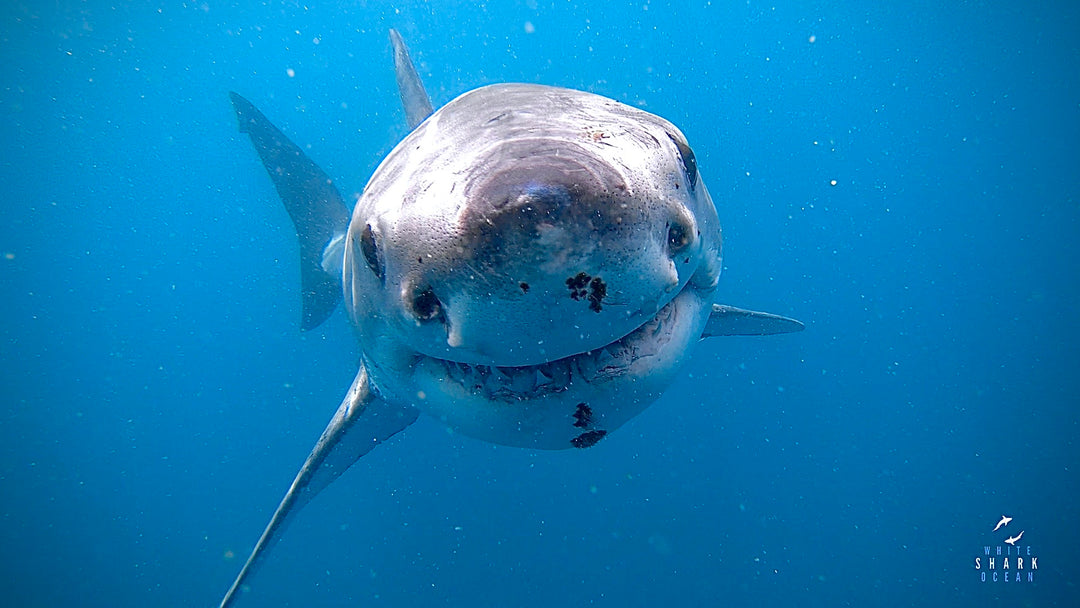
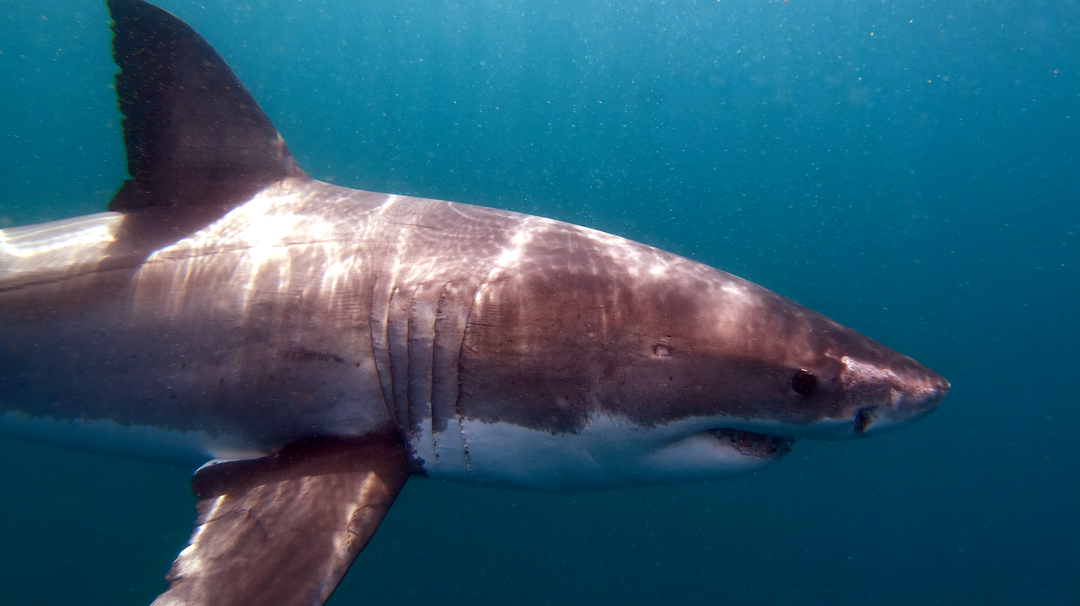
One reason newborn and juvenile great white sharks are rarely recognised for what they are is that they look almost nothing like the adults most people picture. The distinctive two-tone colouration — grey back, white belly — is present from birth, but in very young animals the contrast is less stark, and the body proportions are different. Juvenile great whites have proportionally larger eyes, a more slender body, and a snout that is rounder and less pronounced than in adults.
The teeth are also completely different. As covered in our post on how great white teeth change with age, juvenile great whites have narrow, smooth, unserrated teeth adapted for catching fish and squid. They lack the broad, heavily serrated blades that make adult great white teeth so recognisable. A juvenile great white encountered in shallow coastal water might be mistaken for a different species entirely by anyone not specifically looking for the combination of body shape, fin profile, and colouration that identifies it.
The behaviour is also different. Juveniles hug the coastline, staying in water shallow enough that they can manoeuvre quickly and retreat to shallower areas if threatened. They avoid the deeper open water that adults cross with ease. They are not hunting seals. They are hunting the fish and squid that occupy the inshore zone, using the same ambush instincts as adults but applied to much smaller, faster prey that suits their unserrated teeth.
The Years We Cannot Account For
Between birth and the point at which young great whites begin appearing at the known aggregation sites — Guadalupe, the Farallons, Mossel Bay — there is a significant gap in our knowledge. Young sharks are rarely seen at these sites until they are several years old and several feet larger than at birth. The years in between are spent in nursery areas, but the details of that time — exactly where they go, how far they range, how their social dynamics develop, what survival challenges they face — are almost entirely unknown.
What we do know is that mortality is high. Great white sharks take years to reach reproductive maturity — males at around 26 years, females not until around 33 — and the years of juvenile development represent a long period of vulnerability. A pup born into a nursery area must survive threats from other predators, competition for food, accidental encounters with fishing gear, and the general attrition of early life before it is large enough to be the apex predator its species is known to be. Of the pups born in any given year, only a fraction will reach adulthood.
This is one of the reasons why the reproductive biology of great white sharks makes every adult animal so conservation-significant. Each large great white in the ocean represents the successful navigation of years of juvenile vulnerability, in a species that reproduces slowly and loses a significant proportion of every generation before it can contribute to the next.
Every adult great white shark in Mossel Bay began its life as a five-foot pup in a shallow coastal nursery. White Shark Ocean operates cage diving and surface encounters with these remarkable animals year-round. Book at whitesharkocean.com.
Frequently Asked Questions
Has anyone ever seen a great white shark give birth?
No. Despite decades of research, tagging, and observation at great white aggregation sites around the world, no scientist or diver has ever documented a great white shark giving birth in the wild. We know that great whites give birth to live pups of around 1.2 to 1.5 metres, that gestation takes approximately 18 months, and that litters contain between two and ten pups — but all of this knowledge has been assembled from incidental captures, necropsy of pregnant females, and inference rather than direct observation of birth. The location and circumstances of birth remain one of the least understood aspects of great white biology.
What is the 2024 baby great white shark footage?
In July 2024, wildlife filmmaker Carlos Gauna and UC Riverside researcher Phillip Sternes filmed what is believed to be the first-ever video of a newborn great white shark in the wild, captured by drone off the Santa Barbara coast in California. The shark was approximately five feet long and entirely white, visibly shedding a coating that researchers identified as the remnants of uterine milk — a nutrient secretion produced by the mother during the final stage of gestation. The footage was published in Environmental Biology of Fishes and confirmed by multiple shark researchers as consistent with a great white pup hours to one day old.
Where do baby great white sharks live?
Juvenile great white sharks spend their early years in designated nursery areas: specific stretches of shallow, warm coastline where food is abundant and larger predators are less prevalent. Confirmed nurseries include the Santa Barbara Channel and Carpinteria area in southern California, Vizcaino Bay in Baja California, Mexico, and offshore Long Island, New York — the first confirmed North Atlantic great white nursery. Nursery areas in Australia and South Africa are suspected but less precisely mapped. Juveniles typically inhabit water shallower than 10 metres at temperatures between 16 and 22 degrees Celsius.
What do baby great white sharks eat?
Juvenile great white sharks eat fish and squid — not marine mammals. Their teeth at birth are narrow and smooth, without the coarse serrations that develop in adulthood and are needed for cutting through the thick blubber of seals and sea lions. These unserrated teeth are well suited for gripping slippery fish. The dietary shift from fish to mammals occurs gradually as the shark grows, coinciding with the development of serrated teeth, and represents one of the most significant biological transitions in the animal's life.
How long do juvenile great white sharks stay in nursery areas?
The precise duration varies and is not fully understood due to the difficulty of tracking individual juvenile sharks over multiple years. What is known is that juveniles are consistently present in nursery areas during their early years and begin appearing at the major adult aggregation sites — such as the Farallon Islands off California, Guadalupe Island in Mexico, and sites off South Africa and Australia — only when they are several years old and substantially larger than at birth. The years between birth and first appearance at adult sites represent a period about which relatively little is known, and which is a focus of ongoing research.






Leave a comment