


Older Than Trees: The 450-Million-Year Story of the Shark
16 July 2026 | White Shark Ocean
There is a fact about sharks that stops most people when they first hear it. Sharks are older than trees. Not older than some trees. Older than trees as a concept — older than the moment in evolutionary history when any plant first grew a woody trunk and lifted its leaves above the ground. When the first shark-like animals were swimming in the world's oceans, the land was covered only by low mats of moss and liverwort, nothing taller than a few centimetres, in a world that had not yet invented the forest.
That was approximately 450 million years ago. The first trees would not appear for another 65 million years. And in the time between then and now, the shark lineage has survived every mass extinction event the planet has produced, outlasted the continents in their current configuration, and arrived in the present day as one of the most precisely engineered predators in the history of life on earth.
The great white shark swimming in Mossel Bay today is the inheritor of that record.

What 450 Million Years Actually Means
The number is large enough to be difficult to hold in perspective. Some comparisons help. Sharks predate the Atlantic Ocean, which began forming around 200 million years ago when the supercontinent Pangaea began to split. They predate the dinosaurs, which appeared roughly 230 million years ago and went extinct 66 million years ago. They predate most insects. They almost certainly predate the rings of Saturn, which are estimated to have formed between 100 and 400 million years ago. The shark lineage is so old that it predates most of the familiar features of the planet we live on.
The oldest fossil evidence for shark-like animals comes from minute, tooth-like scales called dermal denticles, found in Late Ordovician sediments approximately 450 million years old, recovered from sites in what are now Colorado, Mongolia, and other locations worldwide. The earliest undisputed shark scales — those that can be confirmed beyond reasonable scientific doubt — are approximately 420 million years old, from Silurian-era rocks in Siberia. In 2022, researchers announced a 439-million-year-old fossil from China representing the oldest species yet found with a fully articulated jaw: a direct ancestor of the lineage that includes every shark alive today.
The World When Sharks Began
To understand what 450 million years means in practice, it helps to picture what the earth looked like at the time. The continents were arranged nothing like they are today. Most land masses were clustered in the southern hemisphere. The atmosphere had less oxygen than it does now. The oceans were warmer and shallower in many places. And the land — every surface above the waterline — was almost entirely bare rock, punctuated only by thin films of primitive plant life: mosses, liverworts, and early non-vascular plants that could not grow more than a few centimetres tall because they had not yet evolved the internal structures needed to transport water upward through a stem.
This world had no forests. It had no soil in the modern sense — soil requires decaying plant material, and there was not enough plant material to decay. It had no insects, no amphibians, and certainly no reptiles or mammals. The most complex life on earth was in the ocean, and the ocean was where all the action was.
Into this ocean came the earliest sharks: small, scale-covered, cartilaginous animals occupying a niche that was just beginning to be defined. They were not the apex predators of their time — that role belonged to the giant sea scorpions and armoured fish that dominated Ordovician and Silurian seas. But they were present, and they were adaptable, and those two qualities would prove to matter more than anything else.
The First Sharks We Can Picture
The oldest complete shark fossils come from the Cleveland Shale of Ohio: specimens of Cladoselache, approximately 380 million years old, preserved in remarkable detail. Cladoselache was unmistakably a shark. It had a streamlined, torpedo-shaped body, two dorsal fins, paired pectoral and pelvic fins, and the asymmetric heterocercal tail — where the upper lobe is longer than the lower — that is still present in great white sharks today. Most specimens were between one and two metres long. They were fast, active predators of fish, and their body plan was so successful that the fundamental architecture has changed remarkably little in the 380 million years since.
By this point, the land had changed. The Late Devonian period, around 385 million years ago, saw the emergence of the first true trees — among them Archaeopteris, a woody-trunked plant with fern-like foliage that formed the world's first forests. The oldest known forest, discovered in upstate New York and described in research from Binghamton University, dates to approximately 385 million years ago. When those first trees were growing, sharks had already been in the ocean for at least 65 million years. They were an established, diversified, globally distributed group of animals before a single leaf ever cast a shadow on the ground.
Five Extinctions, Five Survivals
The geological record contains five recognised mass extinction events: moments in earth history when the majority of species on the planet were wiped out in geologically short periods of time. The shark lineage has lived through all five.
The first, the End-Ordovician extinction approximately 445 million years ago, was caused by a rapid glaciation that dropped sea levels and cooled the oceans catastrophically. It killed an estimated 85% of all marine species. Sharks survived it, possibly because their early distribution included deeper water environments less affected by the surface cooling.
The Late Devonian extinction, around 375 million years ago, was a prolonged period of environmental stress that wiped out roughly 75% of all species over several million years. The armoured fish that had dominated the oceans — the giant placoderms — were essentially eliminated. Sharks, smaller and more adaptable, survived and diversified into the ecological space the placoderms left behind. The period immediately following this extinction is sometimes called the Golden Age of Sharks.
The End-Permian extinction, 252 million years ago, is the largest extinction event in the history of complex life. An estimated 96% of all marine species were lost. The ocean became hot, acidic, and oxygen-depleted. Even the shark record shows a significant reduction in diversity at this point — but the lineage made it through, likely again by retreating to deeper, more stable water and subsisting on whatever prey remained available.
The End-Triassic extinction, 201 million years ago, eliminated another 75% of species and opened the age of the dinosaurs. Sharks survived. The End-Cretaceous extinction, 66 million years ago — the asteroid impact that ended the dinosaurs — eliminated an estimated three quarters of all species on earth. Sharks survived that too, though not without losses. Several major shark lineages disappeared at this boundary. The lineage that would eventually produce the great white shark made it through.
Why They Keep Surviving
The question of why sharks have outlasted so many extinction events is one that palaeontologists have examined carefully, and the answer turns out to be less about any single advantage and more about a combination of traits that function together as a survival system.
Diversity is the most important factor. Sharks as a group are not one ecological strategy — they are dozens. During any extinction event, the species most at risk are those that are ecologically specialised: animals that depend on a specific prey type, a specific temperature range, or a specific habitat. Generalist species, and species with wide geographic ranges, survive at much higher rates. Sharks span every ocean, every depth zone, and an enormous range of diets and ecological roles. No single catastrophe can reach all of them simultaneously.
Cartilage helps too. A skeleton made of cartilage rather than bone requires significantly less energy to build and maintain, which means sharks can survive on less food for longer periods. During extinction events, when prey becomes scarce, this metabolic efficiency is a genuine advantage. The large, oil-filled liver that provides buoyancy — sharks have no swim bladder — also serves as an energy reserve that can sustain the animal through extended periods without feeding.
And the deep ocean, in every extinction event, has functioned as a refuge. Surface conditions during mass extinctions — temperature spikes, acidification, oxygen loss, asteroid winter — are consistently more severe than conditions in deep water. Sharks that lived in the deep, or that could retreat there when conditions deteriorated, had a survival advantage that shallower species lacked.
The Great White at the End of the Line
Carcharodon carcharias is not 450 million years old. The great white shark as a distinct species is considerably younger, appearing in the fossil record roughly 11 million years ago during the Miocene. But it is the product of 450 million years of continuous refinement, each generation inheriting and improving on the adaptations that carried its ancestors through conditions that eliminated the vast majority of life on earth.
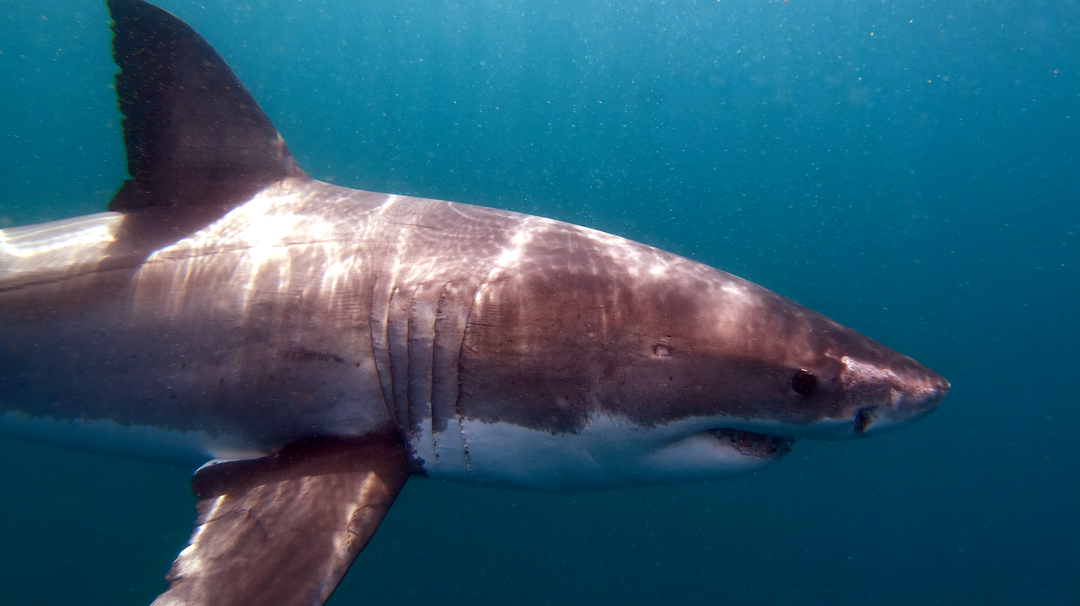
The electroreceptive system that can detect a heartbeat through the water. The immune system that resists cancer and heals rapidly from serious wounds. The jaw that protrudes forward and delivers consistent force regardless of gape angle. The visual system that amplifies available light tenfold and hands off to electroreception at the critical moment. The warm-blooded musculature that delivers explosive speed in cold water. None of these features appeared fully formed. They are the accumulated refinements of an evolutionary lineage that is older than every tree, older than every flower, older than the Atlantic Ocean.
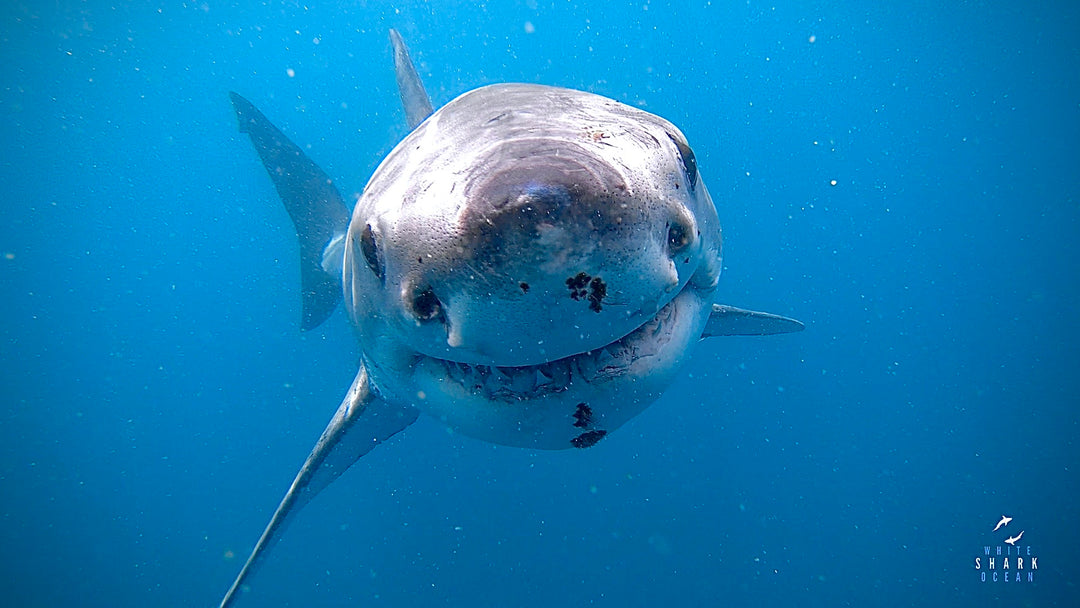
That is the animal in the water at Mossel Bay. The one that approaches the cage, rolls its eye, and turns away. The one that has been here longer than almost anything else on the planet. And the one that, for the first time in 450 million years of survival, is threatened by something that arrived only yesterday.
White Shark Ocean operates cage diving and surface encounters in Mossel Bay, South Africa — one of the best places on earth to observe the world's longest-surviving predator in its natural habitat. Book at whitesharkocean.com.
Frequently Asked Questions
Are sharks really older than trees?
Yes. The shark lineage dates back approximately 450 million years, based on fossil scales (dermal denticles) found in Late Ordovician sediments. The first true trees — woody-trunked plants capable of forming forests — appeared approximately 385 million years ago during the Late Devonian period. This means sharks predate trees by roughly 65 million years. When the first shark-like animals were swimming in the ocean, the land was covered only by low mats of moss and liverwort, and nothing taller than a few centimetres had yet evolved.
How many mass extinctions have sharks survived?
Sharks have survived all five recognised mass extinction events in Earth's history: the End-Ordovician extinction (~445 million years ago), the Late Devonian extinction (~375 million years ago), the End-Permian extinction (~252 million years ago, which killed an estimated 96% of all marine species), the End-Triassic extinction (~201 million years ago), and the End-Cretaceous extinction (~66 million years ago) — the asteroid impact that eliminated the non-avian dinosaurs. While shark diversity was reduced at several of these boundaries, the lineage itself made it through every one.
What was the first shark?
The oldest fossil evidence for shark-like animals consists of minute tooth-like scales called dermal denticles, found in Late Ordovician sediments approximately 450 million years old. The oldest complete shark fossils come from Cladoselache, preserved in the Cleveland Shale of Ohio, dating to approximately 380 million years ago. Cladoselache was unmistakably shark-like: streamlined, one to two metres long, with dorsal fins, paired pectoral fins, and the asymmetric heterocercal tail still present in modern sharks. In 2022, researchers announced a 439-million-year-old fossil from China representing the oldest species found with a fully articulated jaw.
How old is the great white shark as a species?
The great white shark, Carcharodon carcharias, appears in the fossil record approximately 11 million years ago during the Miocene epoch. It is not a 450-million-year-old species — it is, however, the product of a lineage that stretches back that far. The fundamental body plan, sensory systems, and biological strategies that define the modern great white shark are refinements of adaptations that have been in continuous development for nearly half a billion years.
What else did sharks predate?
Sharks predate trees (by ~65 million years), the Atlantic Ocean (which began forming ~200 million years ago), the dinosaurs (which appeared ~230 million years ago), most insects, flowers, and grass. The rings of Saturn are estimated to have formed between 100 and 400 million years ago, meaning sharks likely predate those too. The shark lineage is genuinely one of the oldest continuously surviving vertebrate lineages on Earth.







Leave a comment