


Fewer Than 500 Left: The Quiet Crisis Facing Australia's Great White Sharks
26 June 2026 | White Shark Ocean
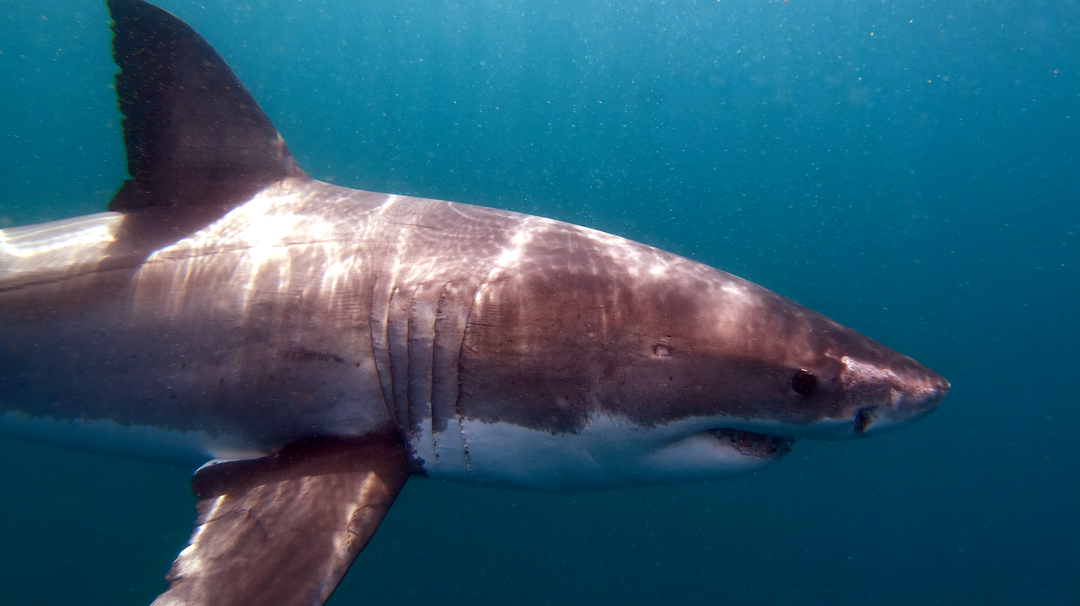
Australia has some of the strongest great white shark protection laws in the world. The species has been listed as Vulnerable under federal environment law since 1999. Harming, killing or trading great white sharks is illegal. The country has invested heavily in shark research, has an active tagging programme, and prides itself on being a global leader in ocean conservation.
It also has fewer than 500 breeding great white sharks left.
Research published in June 2025, drawing on DNA sequence data from more than 600 individual Australian great whites — one of the largest genetic studies of the species ever conducted — found that the entire Australian population is held up by a tiny number of breeding adults. Funded by the New South Wales Department of Primary Industries and Deakin University, the study confirmed what researchers had long feared: the population that once ranged freely across thousands of kilometres of Australian coastline has been reduced to a remnant, and the remnant is under continued pressure.
The cause is not a mystery. It is the same story playing out in South Africa and the Mediterranean, with one critical difference: in Australia, the government has known about the problem for nearly a decade and has explicitly been told to fix it. It has chosen not to.

The Numbers
The eastern Australasian population — covering Australia's east coast and New Zealand — is estimated by CSIRO at approximately 750 breeding adults, with a total population (including juveniles and subadults) of around 5,460. The 2025 genetic study puts the breeding adult figure lower, at fewer than 500 — a number that reflects not just scarcity but genetic fragility.
When researchers analysed the DNA data, they found high levels of genetic relatedness among juvenile and subadult sharks. In a healthy population, you would expect individuals to be largely unrelated. In the Australian sample, close relatives are turning up with striking frequency. This is the signature of inbreeding — what happens when a population becomes so small that individuals repeatedly mate with relatives, eroding genetic diversity and increasing vulnerability to disease, developmental problems, and the accumulation of harmful mutations.
The eastern Australasian population is thought to have declined by more than 90% over the past century. In New South Wales alone, great white shark catch rates dropped by 70% between the 1950s and the present day. In Queensland, the decline is between 60 and 75% since the 1960s. These are not modelled projections. They are documented changes in catch rates from the very shark control programs that are still running today.
The Program That Will Not Stop
Since 1962, Queensland has operated a Shark Control Program along its coastline, deploying nets and baited drumlines at beaches from the Gold Coast to Cairns. The program has killed approximately 50,000 sharks since it began — including bull sharks, tiger sharks, hammerheads, and great whites. It has also killed dolphins, turtles, dugongs, rays and whales. Great white sharks, fully protected under federal law, die in this program routinely.
New South Wales runs a parallel operation: 305 SMART drumlines across 19 coastal government areas, plus nets at 51 beaches between Newcastle and Wollongong. In January 2026, the NSW government announced an expansion of drone surveillance — a welcome addition — but the nets and drumlines remain in place.
In 2017, a Senate Inquiry into shark mitigation and incident reduction examined the evidence and reached an unambiguous conclusion: lethal drumlines should be immediately replaced with non-lethal alternatives, and shark nets should be phased out. The recommendation was grounded in both the conservation evidence — the continuing decline of protected species — and the effectiveness evidence, since non-lethal technologies including SMART drumlines (which catch and release) and acoustic monitoring have been shown to provide comparable beach safety outcomes without the indiscriminate killing.
Both Queensland and New South Wales have ignored this recommendation. Queensland has since invested $60 million in expanding its Shark Control Program, with traditional nets and kill-drumlines at the centre of the package.
What Recovery Actually Looks Like
The northwest Atlantic provides a direct counter-example — and it is instructive.
By the 1960s, the great white shark population off the US east coast had declined by more than 70%, driven by targeted fishing, bycatch and sport killing. In 1997, great whites were designated a prohibited species in US federal waters — no retention allowed, no exceptions. Massachusetts state waters followed in 2005. The killing largely stopped.
The result, two decades later, is one of the clearest shark recovery stories on record. Great whites have returned to Cape Cod in numbers not seen for generations, drawn back by the rebounding grey seal population that followed its own protection measures. A 2023 study estimated between 393 and 1,286 white sharks now using the Cape Cod area seasonally. The Atlantic White Shark Conservancy has tagged hundreds of individuals and built a public tracking system that has done as much to shift public attitudes toward coexistence as any educational campaign.
It is worth sitting with that comparison. In the US, protection was real — not just legislative but operational, meaning the mechanisms that were actually killing the sharks were stopped. The population responded. In Australia, protection exists in law while the mechanisms that kill great whites continue to operate on government contracts.
The South Africa Parallel
Readers of this blog will recognise the pattern immediately. South Africa protected great white sharks in 1991 — the first country in the world to do so — and continued running shark nets and drumlines that kill more than 20 per year. The Mediterranean banned great white capture in 2018 and documented 40 killed in 2025. Australia listed the species as Vulnerable in 1999 and has killed tens of thousands of sharks in the intervening decades through programs that run on public funding.
The common thread is a gap between the protection that exists on paper and the political will to actually remove the infrastructure that drives the decline. Beach safety is a genuine and legitimate public concern. But the evidence increasingly shows that non-lethal alternatives — SMART drumlines, acoustic monitoring, drone surveillance, personal deterrent devices — can deliver comparable safety outcomes without the conservation cost. The choice to maintain lethal programs is no longer defensible on safety grounds. It is a choice, and it has consequences.
Why This Matters Beyond Australia
Great white sharks do not respect national boundaries. The same animals that spend their summers off the coast of New South Wales may travel to New Zealand, to the sub-Antarctic, or across the Indian Ocean. Individual great whites tagged in South Africa have been tracked reaching Australian waters. The species is a global population connected by vast oceanic migrations, and the loss of breeding adults in any one regional population has consequences that extend far beyond that coastline.
Fewer than 500 breeding great whites on one of the longest coastlines in the world. A Senate Inquiry that recommended change in 2017 and was ignored. A genetic signal of inbreeding already present in the juvenile population. And a government that just spent $60 million expanding the program that is making it worse.
The northwest Atlantic shows this can be turned around. The question for Australia is whether it will choose to try — or whether it will wait until the numbers force the issue.
Every great white shark encounter in Mossel Bay directly supports shark conservation research and advocacy. Book with White Shark Ocean at whitesharkocean.com.
Frequently Asked Questions
How many great white sharks are left in Australia?
Research published in June 2025, based on DNA analysis of more than 600 individual Australian great white sharks, estimated fewer than 500 breeding adults remain along the entire Australian coastline. CSIRO's separate estimate puts the eastern Australasian adult population at approximately 750, with a total population including juveniles of around 5,460. Both figures represent a population that has declined by more than 90% since the last century and is showing signs of genetic stress from inbreeding.
Are great white sharks protected in Australia?
Yes — great white sharks have been listed as Vulnerable under Australia's federal Environment Protection and Biodiversity Conservation Act since 1999, making it illegal to harm, kill or trade them. Despite this, both Queensland and New South Wales continue to operate shark control programs that include nets and baited drumlines, which kill great white sharks as bycatch. A 2017 Senate Inquiry recommended the immediate replacement of these lethal measures with non-lethal alternatives, but this recommendation has not been implemented by either state government.
Do shark nets and drumlines in Australia kill great white sharks?
Yes. Queensland's Shark Control Program has been running since 1962 and has killed approximately 50,000 sharks in total, including great whites that are fully protected under federal law. New South Wales operates 305 SMART drumlines and nets at 51 beaches. While SMART drumlines catch and release target sharks alive, traditional drumlines and nets kill indiscriminately. Documented great white shark catch rates in NSW have declined by 70% since the 1950s — figures drawn from the control programs themselves, reflecting decades of population depletion.
How did great white sharks recover in the Atlantic?
The northwest Atlantic recovery followed the designation of great white sharks as a prohibited species in US federal waters in 1997, with Massachusetts state waters following in 2005. With targeted fishing and bycatch retention effectively stopped, the population began to rebound. Great whites have returned to Cape Cod in increasing numbers, drawn by recovering grey seal populations. A 2023 study estimated between 393 and 1,286 white sharks using the Cape Cod area seasonally. The recovery demonstrates that great white populations can rebound when the mechanisms causing mortality are genuinely removed — not just legislated against.
What are non-lethal alternatives to shark nets and drumlines?
Several non-lethal shark mitigation technologies have been developed and trialled in Australian waters, with strong results. SMART (Shark Management Alert in Real Time) drumlines catch sharks alive and allow them to be tagged and released, providing both safety data and conservation benefit. Aerial and drone surveillance identifies sharks near swimming areas and triggers beach closures without killing. Acoustic monitoring detects tagged sharks approaching beaches. Personal deterrent devices using electrical fields disrupt shark sensory systems. A 2017 Australian Senate Inquiry found that these alternatives could deliver comparable beach safety outcomes to lethal programs without the conservation cost, and recommended their adoption as replacements for nets and traditional drumlines.




Leave a comment