


Air Jaws: The Science Behind How Great White Sharks Hunt
1 July 2026 | White Shark Ocean
The image most people carry of a great white shark attack is a sudden eruption at the surface — jaws rising from flat water with almost no warning. The reality is a far more calculated piece of physics. The breach is the end of a trajectory that began 30 metres below, planned around light, timing, geometry, and the shark's knowledge of exactly where its prey will be when the two of them meet at the surface.
Understanding how great white sharks actually hunt changes everything about how you see them. They are not ambush predators in the simple sense. They are ambush predators that have solved the geometry of a moving target using sensory information, environmental conditions, and individual experience — and the solution, when it works, launches a 1,000-kilogram animal entirely out of the water.

The Problem of Hunting Seals
Cape fur seals are not easy prey. A large adult seal can weigh 300 kilograms and move through water at speeds comparable to the shark's own cruising pace. They are agile, they are alert, and they spend their lives in the same waters where great whites hunt. In a straight chase, the outcome is not guaranteed.
The great white's solution is to remove the chase entirely. Rather than pursuing a seal that knows it is being followed, the shark attacks before the seal knows it is being hunted — from directly below, at maximum velocity, before the seal has any chance to change direction.
This requires solving a geometric problem. The shark needs to be in the right position below the seal, moving in exactly the right direction at exactly the right speed, to intercept the seal at the surface with enough force to incapacitate it before it can react. Starting from 30 metres down, in water that is often dark and turbulent, without the seal detecting any approaching pressure change or shadow until the moment of impact.
Countershading: The Camouflage System
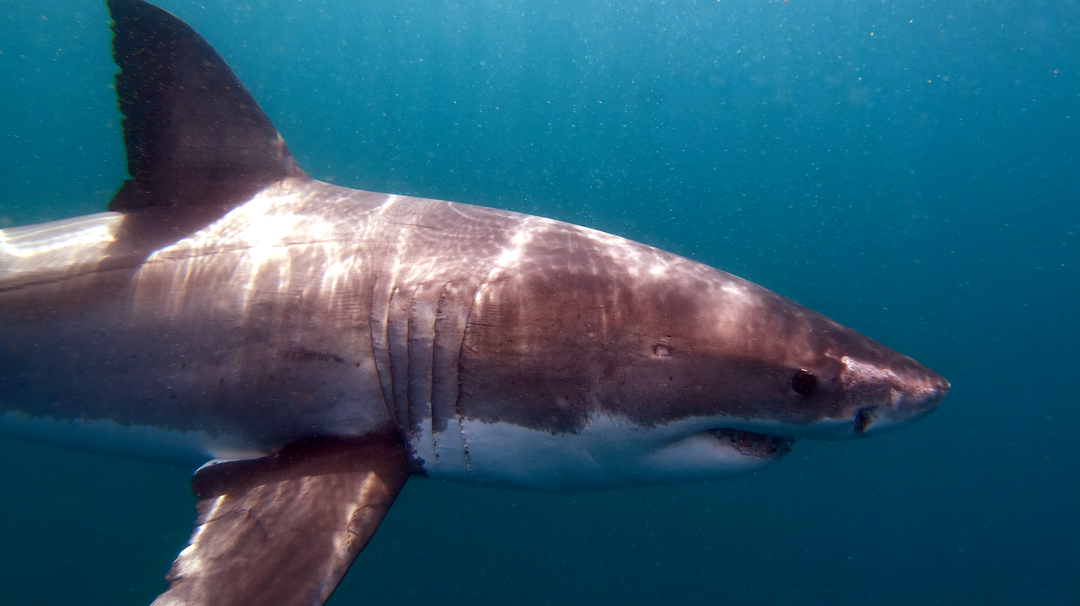
Before the attack begins, the shark needs to be invisible. Great white sharks are countershaded — dark grey or blue-grey on the dorsal surface, white on the ventral surface. This is not incidental colouration. It is a camouflage system precisely calibrated for hunting in the ocean's light gradient.
From above, looking down into the water, the shark's dark back blends with the deep, dark ocean. A seal looking down from the surface sees neither the shark's outline nor its movement against the uniform darkness below. From below, looking up toward the surface, the shark's white belly blends with the bright, diffuse light filtering down from above. An animal looking up at a white-bellied shark cannot distinguish it from the bright surface behind it.
The shark is simultaneously invisible from the only two angles that matter — and it hunts from the angle where both advantages apply at once. It sits below the target, invisible against the dark, watching the seal silhouette itself against the bright surface above.
Timing and the Dawn Advantage
At Seal Island in False Bay, the most studied site for breach attacks in the world, great white sharks show a strong preference for hunting at dawn. Research recording attacks over many years found a success rate of around 55% in the first hour of light, dropping to approximately 40% by mid-morning, and declining further through the day.
The reason is the light gradient. At dawn, the surface is bright relative to the depths, maximising the contrast that makes seals visible from below while keeping the shark invisible. As the sun rises and the water column becomes more uniformly lit, the advantage narrows. The shark's camouflage works best in the specific lighting conditions of early morning, and its hunting schedule reflects this.
Seals leaving Seal Island for their morning feeding runs must cross open water. The sharks know this and position themselves along the routes the seals consistently use. Individual sharks have been observed using different approach angles — some approaching from the east at dawn to keep the rising sun behind them, others selecting routes based on the seal's direction of travel. Research suggests that individual sharks at Seal Island develop distinct hunting strategies over time, learning from experience which approaches are most likely to succeed.
The Physics of the Breach
The attack begins 7 to 31 metres below the surface, with most starting closer to the 30-metre depth. The shark identifies the seal's silhouette, calculates the intercept trajectory, and accelerates vertically.
The speed required for a full breach is significant. To carry a shark of 1,000 kilograms completely clear of the water surface, the animal needs to be moving at approximately 25 miles per hour at the moment it hits the surface. Some estimates put burst speeds during the attack even higher. This velocity is built across 30 metres of near-vertical acceleration, with the shark's body essentially functioning as a missile aimed at a point slightly ahead of where the seal currently is, to account for the seal's movement during the ascent.
The impact, when contact is made, is designed to kill or incapacitate the seal before it can react. The force of a thousand-kilogram predator at 25 miles per hour is not something that can be escaped by agility once it connects. The strategy is not to chase the seal. The strategy is to make the chase unnecessary.
When the geometry is right and the timing is precise, the momentum carries the shark entirely out of the water. The result is the breach — a spectacle that was first photographed by Chris Fallows off Seal Island in the 1990s and eventually gave a name to the entire phenomenon: Air Jaws.
What Happens When It Doesn't Work
The breach is successful roughly half the time — studies at Seal Island put the average across all conditions at around 47%. When it fails, it tends to fail at the geometry: the seal turns at the last moment, the shark's trajectory is slightly off, or the seal detects the approaching pressure change through its own sensory system and reacts in time.
When the initial strike misses or fails to incapacitate, the shark's behaviour shifts. Rather than immediately re-attacking, it typically circles and waits. A seal that has been struck but not killed is wounded, weakened, and producing an intensifying electrical and chemical signature. The shark, having already expended enormous energy on the initial strike, waits for the prey to tire. The patience is not passivity — it is part of the strategy.
Individual sharks that have been observed over multiple seasons show increasing success rates as they age. The geometry of the attack can be learned and refined. Older, more experienced sharks at Seal Island achieve higher success rates than younger ones. The breach is not just physics. It is a skill.
False Bay, Seal Island, and What Has Changed
For two decades, Seal Island in False Bay near Cape Town was the global centre of Air Jaws research and wildlife tourism. The island hosts approximately 64,000 Cape fur seals and the seasonal concentration of great whites around it produced some of the most extraordinary predator footage ever filmed.
By 2020, the great whites had largely left. The arrival of Port and Starboard — the two male orcas whose liver-extraction technique is documented in our post on the rete mirabile — displaced the sharks from False Bay almost entirely. The seals remain. The breach attacks no longer happen there with any regularity.
The great whites have not disappeared from South African waters entirely. They have redistributed — including to Mossel Bay, where different prey dynamics and different environmental conditions produce different hunting patterns. The precise vertical ambush of Seal Island is specific to that combination of water depth, seal behaviour, and light conditions. In other locations, the same predators hunt differently, adapting their strategy to the environment they are in.
The Air Jaws phenomenon was a window into one specific, extraordinary expression of great white hunting behaviour. The shark is capable of more variation than the breach alone suggests.
White Shark Ocean operates cage diving and surface encounters in Mossel Bay, where these animals can still be seen in their natural environment. Book at whitesharkocean.com.
Frequently Asked Questions
Why do great white sharks breach when hunting seals?
Breaching is the result of a vertical ambush attack launched from depth. The shark approaches from directly below at high speed, using the ocean's light gradient as camouflage. Its dark back is invisible against the dark deep water; the seal cannot detect it from above. The shark accelerates vertically toward the seal's silhouette, and the speed required to hit the seal with sufficient force at the surface carries the shark's momentum entirely out of the water. The breach is not the goal — it is the physical consequence of a successful high-speed intercept from below.
How fast does a great white shark move when it breaches?
To carry a great white shark completely clear of the water surface, the shark needs to be travelling at approximately 25 miles per hour at the moment of impact. Some estimates put burst speeds during the attack higher than this. This velocity is built across a near-vertical acceleration run of up to 30 metres, with the entire ascent taking only a few seconds. The force delivered to the prey at impact is the product of both speed and mass — a thousand-kilogram predator moving at this velocity produces an impact calculated to incapacitate the seal before it can react.
What is the success rate of a great white shark breach attack?
Research studying great white shark attacks at Seal Island in False Bay found an average success rate of around 47% across all conditions. At dawn — when the light gradient is most favourable and the camouflage most effective — success rates are closer to 55%. By mid-morning, as the water column becomes more uniformly lit and the contrast advantage narrows, success rates drop to around 40%. Individual sharks improve their success rates with experience, and older sharks at Seal Island have been observed achieving significantly higher success rates than younger ones.
What is countershading and why does it help great white sharks hunt?
Countershading refers to the great white's dark dorsal (upper) surface and white ventral (lower) surface. This colouring provides camouflage from both key angles of observation: from above, the dark back blends with the dark deep water below; from below, the white belly blends with the bright diffuse light at the surface. When a great white hunts from below, it is simultaneously invisible to its prey looking down and invisible to any observer looking up. The system is most effective in the specific lighting conditions of dawn, which is why great whites at known hunting sites strongly prefer to attack at first light.
Where can you see great white sharks breaching?
Seal Island in False Bay, near Cape Town, was historically the primary location for witnessing great white shark breach attacks and was the site where the Air Jaws phenomenon was first documented and filmed. However, great white sharks largely abandoned False Bay after orca activity disrupted the population from around 2017 onwards. Breach attacks in their classic form are now rarely seen at Seal Island. Great white sharks remain active at other South African locations including Mossel Bay, where White Shark Ocean operates cage diving and surface encounters year-round.




Leave a comment