


The Most Dangerous Mouth in the Ocean: How a Great White Shark's Jaw Actually Works
15 July 2026 | White Shark Ocean
If you were designing the most effective biting mechanism in vertebrate history, you would probably start with what most animals have: an upper jaw fused solidly to the skull, providing a stable platform for the lower jaw to close against. This is what humans have. It is what crocodilians have. It is what almost every biting vertebrate on earth has.
Great white sharks do not have this. Their upper jaw is not fused to their skull at all. And the reason why is one of the most elegant pieces of evolutionary engineering in the ocean.

A Jaw Unlike Any Other
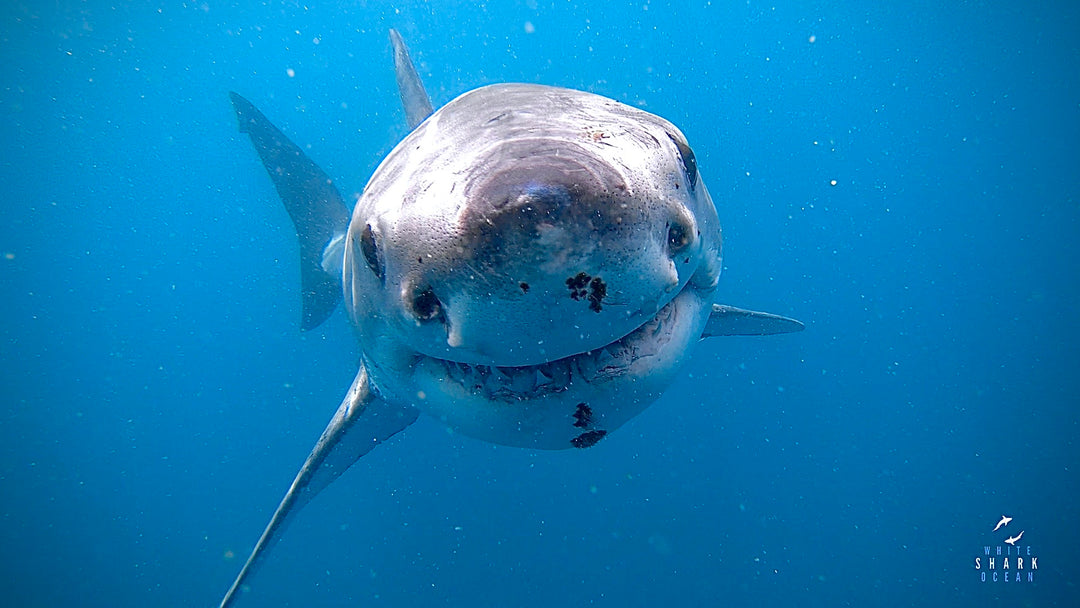
In most vertebrates, the upper jaw (the palatoquadrate in fish, the maxilla in mammals) is rigidly attached to the cranium. This gives the animal a solid mechanical foundation to bite against. In sharks, this connection is loose. The palatoquadrate — the great white's upper jaw cartilage — is suspended beneath the skull by ligaments and supported by a structure called the hyoid arch, in an arrangement called hyostylic jaw suspension. The jaw is held in place and oriented correctly, but it can move independently of the skull in ways that a fused upper jaw simply cannot.
When a great white shark bites, both jaws move simultaneously, but in opposite directions, and the upper jaw does something no fused jaw can do: it protrudes. Two sets of muscles — the preorbitalis and the levator palatoquadratii — pull the palatoquadrate forward and downward, thrusting it out beyond the front of the snout. At the same time, the hyoid arch rotates forward to brace the protruding jaws from behind, locking them in their extended position for the duration of the bite. The lower jaw drops simultaneously, widening the gape.
The result is that the shark's effective reach at the moment of a bite is significantly greater than its head dimensions at rest would suggest. The jaws extend beyond the snout, the gape widens, and the entire biting apparatus is projected toward the prey rather than simply closing around it. The whole sequence — protrusion, bite, and retraction — happens in a fraction of a second.
The Suction Effect
The forward rotation of the hyoid arch does more than brace the protruding jaws. As the hyoid swings forward, it expands the volume of the throat cavity, creating a partial vacuum that generates suction. This draws water — and whatever prey is in that water — toward and into the open mouth in the instant before the jaws close.
This suction component is not the dominant mechanism in a great white's attack the way it is in some other fish that are pure suction feeders. Great whites are primarily bite predators, closing their jaws with force rather than drawing prey in passively. But the suction contributes to the precision and completeness of the bite, ensuring that prey which might otherwise slip sideways at the critical moment is drawn fractionally closer to the closing teeth. For an animal hunting slippery, fast-moving marine mammals, that fraction matters.
Force That Does Not Diminish
In 2008, a team led by Stephen Wroe at the University of New South Wales published a three-dimensional computer analysis of great white shark jaw mechanics in the Journal of Zoology. The study calculated that a large great white shark can generate a bite force of up to 18,216 newtons — approximately 4,000 pounds of force — making it one of the most powerful biting animals alive.
But the raw figure is not the most interesting finding. The most interesting finding is what happens to that force at different gape angles.
In mammals, including humans, bite force drops significantly as the mouth opens wider. This is a consequence of muscle mechanics: jaw-closing muscles generate less force when they are stretched toward their maximum extension. A human biting down lightly produces a much weaker bite than one biting with a small gape. The same principle applies to lions, dogs, crocodilians — almost any vertebrate that bites.
Great white sharks are an exception. The arrangement and geometry of their jaw muscles allows them to maintain near-maximum bite force across a wide range of gape angles. Whether the jaw is barely open or as wide as it can go, the force delivered is roughly consistent. For an animal that needs to bite through the thick blubber and bone of a large marine mammal in a single strike — often at an awkward angle, from below, while moving at speed — this consistency is mechanically crucial. The shark does not need to position its prey carefully before biting. It bites hard regardless of the geometry of the moment.
Teeth as Tools, Not Just Weapons
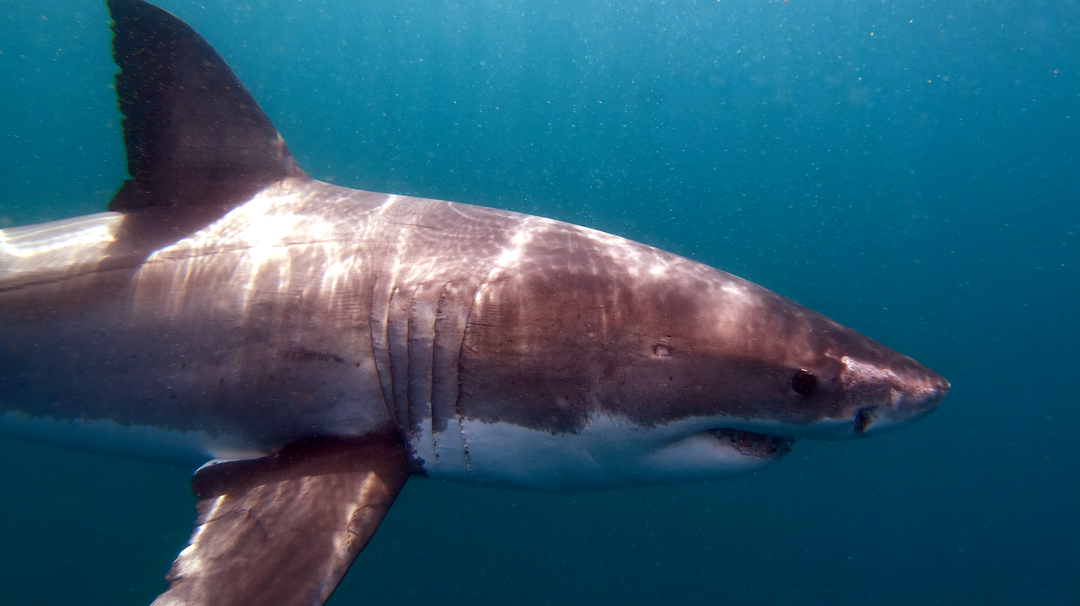
The jaw mechanics cannot be understood separately from the teeth that sit in those jaws. Adult great white teeth are triangular, broad-based, and coarsely serrated along both cutting edges. The serrations are not for applying initial force — they are for what happens after the jaw closes.
Once the initial bite is made, the shark's head shakes laterally in a rapid side-to-side motion. Anyone who has seen a dog shake a toy gets the visual: the prey is gripped and the head moves in a sawing pattern that drags the serrated edges of the teeth through tissue with each oscillation. The serrations create stress points that concentrate cutting force along their tips, propagating tears through flesh the way a bread knife cuts better than a smooth one. The combination of the initial bite force and the subsequent lateral shaking is what allows a great white to remove substantial portions of prey tissue cleanly and efficiently.
The upper teeth and lower teeth serve different mechanical roles during this process. The upper teeth, which are broader and more heavily built, tend to anchor and stabilise the prey during the shake. The lower teeth, which are narrower and more pointed, penetrate and grip. Together they function as a coordinated system rather than a single uniform set of cutters.
How It Compares to Other Biters
The 18,216-newton bite force figure invites comparison with other animals known for powerful bites. Saltwater crocodiles, the most frequently cited rivals, produce estimated bite forces of 16,000 to 34,000 newtons — comparable or higher at the upper end. However, the crocodilian bite is a clamping mechanism with smooth or conical teeth designed for holding prey, not cutting it. The great white's combination of force, tooth geometry, and lateral shaking produces a tissue-removal capability that a crocodilian bite does not replicate.
Hippos generate around 8,100 newtons. Lions around 1,800 newtons. Humans, at maximum effort, produce roughly 700 newtons. The great white's jaw system does not simply outperform these animals in force — it operates on a different mechanical principle that makes the comparison only partly meaningful. Force is one variable. The protruding jaw, the suction component, the gape-independent force maintenance, and the serrated-tooth lateral shaking together constitute a system that no land-based predator independently evolved.
The Investigative Bite
Understanding the jaw mechanics also helps explain a behaviour that is frequently mischaracterised in discussions of shark attacks on humans: the investigative or "bump and bite" approach.
Great whites are cautious about committing to a full feeding strike on unfamiliar prey. An adult great white that approaches an unknown object — including a human in the water — will often make an initial contact that is lighter than a full feeding bite: a brief closing of the jaws that provides tactile and chemical information about the target without committing to the full mechanical sequence of protrusion, force, and lateral shaking. This is a controlled application of a system that is capable of far more force than is typically used in these exploratory contacts. The jaw mechanics that can deliver 18,000 newtons can equally deliver a much lighter touch — and frequently do, when the shark is gathering information rather than feeding.
Most encounters between great white sharks and humans fall into this category. The shark investigates, finds that the human does not match the sensory profile of its preferred prey, and disengages. The bite force and jaw mechanics that make a great white so formidable as a predator of marine mammals are not typically applied to humans in full — which is why most people who are bitten by great whites survive.
White Shark Ocean operates cage diving and surface encounters in Mossel Bay, South Africa, where you can observe great white shark behaviour safely and up close. Book at whitesharkocean.com.
Frequently Asked Questions
How strong is a great white shark's bite?
A large great white shark can generate a bite force of up to 18,216 newtons (approximately 4,000 pounds-force), according to a 2008 three-dimensional computer analysis published in the Journal of Zoology. This makes it one of the most powerful biters among living animals. Importantly, great white sharks maintain near-maximum bite force across a wide range of gape angles — unlike mammals, whose bite force drops significantly as the jaw opens wider. This means a great white does not need to position prey carefully before biting; it delivers close to maximum force regardless of gape.
Does a great white shark's jaw detach when it bites?
Not detach, but protrude. The great white's upper jaw (the palatoquadrate) is not fused to the skull — it is loosely suspended by ligaments and the hyoid arch. When the shark bites, two sets of muscles thrust the upper jaw forward and downward beyond the snout, extending the shark's effective reach and widening the gape. The hyoid arch simultaneously rotates forward to brace the protruding jaws and creates a partial suction that draws prey toward the mouth. The whole sequence happens in fractions of a second. The jaw retracts to its resting position after the bite.
Why do great white sharks shake their heads when biting?
The lateral head shake that follows the initial bite is what the serrated teeth are primarily designed for. Once the jaw has closed on prey, the shark's head shakes rapidly side to side, dragging the serrated edges of the teeth through tissue in a sawing motion. The serrations create stress concentrations along their tips that propagate tears through flesh efficiently — the same principle as a serrated bread knife cutting more effectively than a smooth one. Upper and lower teeth play distinct roles: upper teeth anchor and stabilise while lower teeth penetrate and grip.
Why do great white sharks sometimes bite and release?
Great white sharks frequently use a lighter initial bite when approaching unfamiliar prey — including humans. This investigative contact provides tactile and chemical information about the target before the shark commits to a full feeding strike. If the prey does not match the sensory profile the shark associates with its preferred food (primarily marine mammals), the shark typically disengages. This is why the majority of great white shark bites on humans result in a single contact rather than sustained feeding: the shark investigates, determines the human is not appropriate prey, and leaves. The jaw system capable of 18,000 newtons of force is not applied in full during these exploratory contacts.
How do great white shark teeth compare to megalodon teeth?
Great white teeth are broadly triangular with coarse, irregular serrations — designed for both initial penetration and the lateral cutting motion of the head shake. Megalodon teeth were also large and triangular but had finer, more regular serrations and a different root structure. Despite their visual similarity — which led to the long-held belief that the two species were closely related — detailed morphometric analysis has confirmed that the teeth represent convergent evolution rather than shared ancestry. The two species were on entirely separate evolutionary lineages for tens of millions of years before megalodon went extinct.






Leave a comment