


The Domino Effect: What a 2025 Study Revealed After Great White Sharks Left False Bay
13 July 2026 | White Shark Ocean
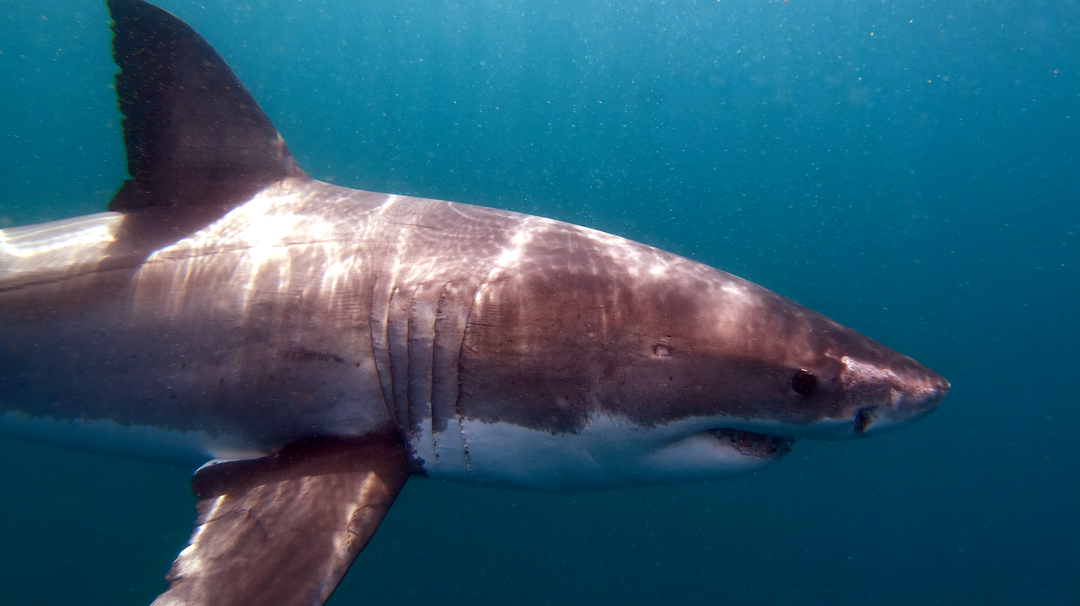
Between 2015 and 2019, great white shark sightings in False Bay, South Africa, collapsed to near zero in the space of three and a half years. One of the most studied great white populations on earth — the same animals that made Seal Island famous for breach attacks, the same population that inspired two decades of Air Jaws research — was gone. At the time, the cause was uncertain and the ecological consequences were still unfolding.
In March 2025, a team from the University of Miami Rosenstiel School of Marine, Atmospheric and Earth Science published a study in Frontiers in Marine Science that drew on two decades of monitoring data to document exactly what happened next. What they found was not a gradual adjustment. It was a cascade — and it is still accelerating.

Why the Sharks Left
The great white sharks did not simply move on from False Bay. Their disappearance was driven by two compounding pressures that had been building for years.
The first was bather protection nets. South Africa's shark net programme, which has operated along KwaZulu-Natal and Western Cape coastlines for decades, kills sharks indiscriminately. Great white sharks are protected under South African law, but nets do not discriminate by species. Over decades, cumulative mortality in nets had reduced the False Bay population to a point where it was no longer robust enough to sustain consistent presence. The nets intended to protect people on beaches were quietly removing the animals from the water.
The second pressure arrived more suddenly: orcas. Port and Starboard, two male orcas first documented off the South African coast around 2015, developed a highly specific hunting technique targeting the livers of great white sharks. The pair were documented killing great whites in False Bay, and the sharks responded in a way consistent with behaviour seen elsewhere when orcas are present — they left. Great white sharks that encounter orcas have been tracked leaving areas within hours and not returning for months or years. By 2019, their presence in False Bay had effectively ceased.
What Happened to the Seals
The most immediate and visible change documented in the 2025 study was in the behaviour and distribution of Cape fur seals. Seal sightings in the study area surged by 522% following the disappearance of the great whites.
The number alone understates the behavioural shift. Cape fur seals had historically maintained a tight relationship with the shoreline and island haul-out sites, clustering in shallow water where they could respond to an approaching shark by reaching the shore or rocks quickly. The vertical ambush attack that made Seal Island famous only worked because the seals were silhouetting themselves against the bright surface in water deep enough for a shark to build attack speed from below. The seals had learned to live within those constraints.
Without the constraints, the behaviour changed. Seals began rafting — resting on the surface in groups — in the open, deep water of False Bay. These were locations they had never used before, for the simple reason that using them would previously have been fatal. A follow-up study measuring cortisol levels — the primary stress hormone — in Cape fur seal populations in the area found levels had dropped significantly. The biochemical signature of an animal living in fear had dissipated. The seals were no longer afraid, because there was nothing left in False Bay to be afraid of.
The Sevengill Takeover
Into the vacancy left by the great whites came an unexpected replacement: the broadnose sevengill shark, a species that had previously kept well away from Seal Island and the deep open waters of False Bay.
Sevengill sharks are powerful predators, capable of hunting Cape fur seals, but they are not great whites. They are found primarily in the kelp forests and shallower coastal areas of False Bay, more than 20 kilometres from Seal Island. The reason they stayed away from the deeper open water was the same reason they now moved in: great whites. A sevengill shark that ventured into great white territory was itself at serious risk. The great whites had functioned not only as a predator of seals but as a suppressor of other predators — an ecological ceiling that kept the sevengill population in its place.
When that ceiling was removed, the sevengills expanded. They began appearing at Seal Island, in depths and locations consistent with targeting the now-emboldened seal population. A new apex predator had filled the vacancy — but it was filling it imperfectly, because a sevengill shark is not ecologically equivalent to a great white. The prey it targets, the depths it can reach, and the population dynamics of the species are all different.
The Cascade Below
The 2025 study tracked the effects further down the food chain, and what it found illustrates why losing an apex predator is not simply a matter of losing one species.
As seal numbers and boldness increased, and as sevengill sharks expanded their range and predation pressure, the species those animals feed on began to decline. The study documented a 44% reduction in summer populations of Cape horse mackerel in the area — a species that forms a critical part of the diet of both seals and the fish that compete with seals for food. Anchovy populations, another key prey item for seals, also declined. Sevengill prey species — including smoothhound sharks and pyjama catsharks — showed population pressure consistent with increased predation from the newly expanded sevengill population.
Perhaps most troubling was the effect on critically endangered African penguins. African penguins share coastal habitat with the Cape fur seal colonies, and as the seal colonies expanded in size and geographic range — no longer suppressed by the fear of great whites — the penguins found themselves sharing space with a much larger, more confident competing predator. Seal predation pressure on penguin populations increased, adding another burden to a species already facing severe decline from other causes.
None of this was the intended consequence of any single decision. The shark nets were not installed to collapse an ecosystem. The orcas were not acting maliciously. But the result, documented across two decades of data, is a chain reaction in which the loss of a single apex predator produced changes at every level of the food web below it.
False Bay as a Case Study
What makes the False Bay data so scientifically valuable is its specificity. The great white shark disappearance was rapid enough and complete enough that the before-and-after comparison is unusually clean. Researchers had two decades of baseline data on seal behaviour, sevengill distribution, fish populations, and ecosystem structure — and they could compare that baseline against what happened after a single variable changed at the top of the food chain.
The results align with what ecologists have long predicted from trophic cascade theory, but rarely been able to document in a real-world marine system at this resolution. They provide empirical evidence, with specific numbers, for what had previously been argued largely from modelling and from less complete datasets. A 522% increase in seal sightings is not an abstraction. A 44% reduction in Cape horse mackerel is not a theoretical outcome. These are measured changes in a specific bay, driven by the removal of one species.
The False Bay case is also a reminder that the consequences of losing apex predators are not always immediately visible at the surface. Nobody looked at False Bay in 2019 and saw a collapsed ecosystem. What they saw was an empty sea. The collapse was happening underneath, in the changed behaviour of seals, the expanded range of sevengills, the declining fish that sustain the whole system, and the beleaguered penguin colonies on the shoreline. By the time it is fully visible, it is much harder to reverse.
The same great white sharks whose absence is reshaping False Bay are present in Mossel Bay, where White Shark Ocean operates cage diving and surface encounters year-round. Book at whitesharkocean.com.
Frequently Asked Questions
Why did great white sharks disappear from False Bay?
The 2025 University of Miami study identified two compounding causes. The first was decades of cumulative mortality in bather protection shark nets, which had steadily reduced the False Bay great white population to a point where it lacked the resilience to sustain consistent presence. The second was the arrival of orcas — specifically the two male orcas known as Port and Starboard — who developed a technique for hunting great white sharks and extracting their livers. Great white sharks exposed to orca predation have been consistently documented leaving areas rapidly and not returning for extended periods. The combined effect was the near-total disappearance of great whites from False Bay by 2019.
What happened to the seals after the great white sharks left False Bay?
Cape fur seal sightings in the study area increased by 522% following the disappearance of great white sharks. More significantly, seal behaviour changed fundamentally: animals that had historically kept close to shorelines and haul-out rocks — to maintain an escape route from ambush attacks — began rafting in open, deep water for the first time. Cortisol (stress hormone) levels in seal populations dropped measurably, indicating that the constant predation pressure of living alongside great white sharks had been biochemically significant for the seals themselves.
What is a trophic cascade and why does the False Bay case matter?
A trophic cascade is a chain reaction that propagates through a food web when an apex predator is removed. The False Bay case is significant because it provides unusually specific empirical data for what was previously argued primarily from models and theory. Researchers had two decades of baseline monitoring data, allowing them to document specific numerical changes: seal sightings up 522%, Cape horse mackerel down 44%, sevengill sharks expanding into new habitat, and cascading pressure on species as far removed from the shark as critically endangered African penguins. The specificity of the data makes it one of the most detailed documented marine trophic cascades on record.
What are sevengill sharks and why did they replace great whites in False Bay?
Broadnose sevengill sharks are a coastal apex predator found primarily in the kelp forests and shallower areas of False Bay. They are capable of hunting Cape fur seals but had historically been suppressed from the deeper open water around Seal Island by the presence of great white sharks, which would predate or displace them. When the great whites disappeared, the ecological ceiling that kept sevengill sharks in their original range was removed, and they expanded into the vacant habitat. The sevengills are not ecologically equivalent to great whites — they hunt differently, reach different depths, and have different population dynamics — but in the absence of any other apex predator, they filled the vacancy as best they could.
Can the False Bay ecosystem recover if great white sharks return?
The honest answer is that this is unknown. Trophic cascades can sometimes be reversed if the apex predator returns before the ecosystem has shifted too far from its original state, but the changes documented in False Bay — seal population expansion, sevengill range expansion, fish population declines, and increased pressure on African penguin colonies — represent a significant restructuring that has been developing since 2015. Whether returning great whites would suppress the sevengills back into the kelp forests, whether seal populations would contract and change their behaviour in response to renewed predation pressure, and on what timescale any of this might occur are questions that can only be answered by monitoring what actually happens — if and when great white sharks return.




Leave a comment