


Running on Empty: How Great White Sharks Cross Oceans Without Eating
28 June 2026 | White Shark Ocean
In November 2003, a team of researchers tagged a female great white shark off the coast of South Africa. They named her Nicole, after the actress Nicole Kidman. Over the next 99 days, Nicole swam 6,900 miles across the Indian Ocean to Western Australia — the longest open-ocean crossing ever documented for a shark, completed at an average speed of about 2.8 miles per hour, non-stop. She then turned around and swam home.
She did not stop to eat.
That fact alone is remarkable. A 1,500-pound apex predator crossing an entire ocean — twice — on energy reserves she built up before she left. For years, scientists suspected this was how great white migrations worked, but they couldn't prove it. The question was: where exactly does a great white shark store enough energy to fuel a journey that would exhaust most mammals within days?
The answer is the liver. And once you understand what is inside it, a lot of things about great white sharks start to make sense.

The Fuel Tank
Great white shark livers are extraordinary organs. In an adult great white, the liver can account for up to 28% of the animal's total body weight — in a 1,500-pound shark, that is a liver weighing more than 400 pounds. It fills a substantial portion of the body cavity, and when fully stocked before a long migration, up to 90% of the liver's mass is lipid: fat and oil stored in the densest possible concentration.
The dominant compound is squalene, a hydrocarbon (C30H50) that is significantly less dense than seawater. This matters for two reasons. First, squalene is extraordinarily energy-dense — a single well-provisioned great white liver contains hundreds of thousands of calories, enough to sustain the animal through weeks or months of open-ocean travel without any food intake. Second, because squalene is lighter than water, it provides buoyancy. Great white sharks, unlike bony fish, have no swim bladder. The liver is what keeps them neutrally buoyant — and the more oil it contains, the more effortlessly they float.
This creates an elegant, if brutal, efficiency: the same organ that keeps the shark from sinking also powers it across the ocean. As the lipids are metabolised for energy during migration, the shark slowly becomes less buoyant. It burns its fuel tank from the inside.
How Scientists Proved It
The research confirming this mechanism, published in the Proceedings of the Royal Society B, used a technique that required no blood samples, no dissections, and no direct liver measurements. It used drift dives.
When a great white shark stops actively swimming, it does not immediately sink. Instead, it enters a passive glide — a "drift dive" — during which its rate of descent is determined almost entirely by its buoyancy. A shark with a full, oil-rich liver sinks slowly. A shark with a depleted liver sinks faster.
By fitting satellite tags to migrating great whites and recording the rate of drift during passive glides across thousands of miles of open ocean, researchers were able to track the depletion of liver oil in real time — without ever touching the animals. The data confirmed the pattern unambiguously: buoyancy decreases steadily and consistently across the entire migratory route. The sharks were burning their livers, mile by mile, all the way across the ocean.
The Gorging Strategy
To understand why great whites can do this, you have to understand what they do before they leave.
California great whites that make the 2,500-mile crossing to the mid-Pacific each year spend the preceding months feeding intensively in the rich waters of the California Current, targeting energy-dense prey — elephant seals, sea lions, and cetaceans. They are not eating to satisfy daily metabolic needs. They are loading. Every successful hunt is converted directly into lipid reserves in the liver, which grows progressively larger and denser as departure approaches.
Then they leave — crossing the open Pacific to a convergence zone halfway between Baja California and Hawaii that researchers have dubbed the "White Shark Café". The waters there offer almost nothing in the way of prey. For years, scientists were baffled about why the sharks gathered there at all. Recent research suggests they may be feeding on small deep-water prey during night-time vertical dives, but the caloric contribution is modest. The crossing itself — and the time spent there — runs largely on reserves built up before departure.
It is a physiology built for feast-and-fast cycling on a scale that has no parallel in most ocean predators. A great white shark's entire body plan, from its cartilaginous skeleton (lighter than bone) to its massive liver, is optimised for storing, transporting, and burning oil across vast distances.
The Orcas Knew First
Here is the detail that ties this together in an unexpected way.
When Port and Starboard — the two male orcas responsible for displacing great white sharks from South Africa's False Bay — attack a great white, they do not eat the whole animal. They extract a single organ with what researchers describe as near-surgical precision: the liver. They ram the shark, flip it upside down to induce tonic immobility, force open the body cavity, and remove the liver intact. The rest of the carcass, sometimes thousands of pounds of muscle and tissue, is left floating at the surface.
Scientists spent years trying to understand why. The answer, once the liver research was understood, is straightforward: the liver is by far the most calorie-dense part of the animal. Packed with hundreds of thousands of calories of squalene-rich lipid, a single great white liver represents more usable energy than the rest of the carcass combined. Port and Starboard are not being wasteful. They are being extraordinarily efficient.
The orcas understood the value of the great white's liver long before the Royal Society published the science. Behaviour and biology had arrived at the same conclusion through completely different routes.
What This Means
The liver-powered migration story changes the way you think about great white sharks. They are not roaming the ocean randomly, hunting wherever opportunity arises. They are executing precise, long-distance journeys on a metabolic schedule — feeding intensively in specific locations at specific times of year, building reserves to an exact threshold, then deploying those reserves across thousands of miles of open ocean with extraordinary efficiency.
Nicole's 12,400-mile round trip was not an anomaly. It was the system working as designed. A body built to store energy, a navigation system precise enough to cross an ocean and return, and a metabolism flexible enough to run for months on internal reserves. It is one of the most sophisticated long-distance travel systems in the natural world — and it is powered by oil, carried in a liver the size of a small child.
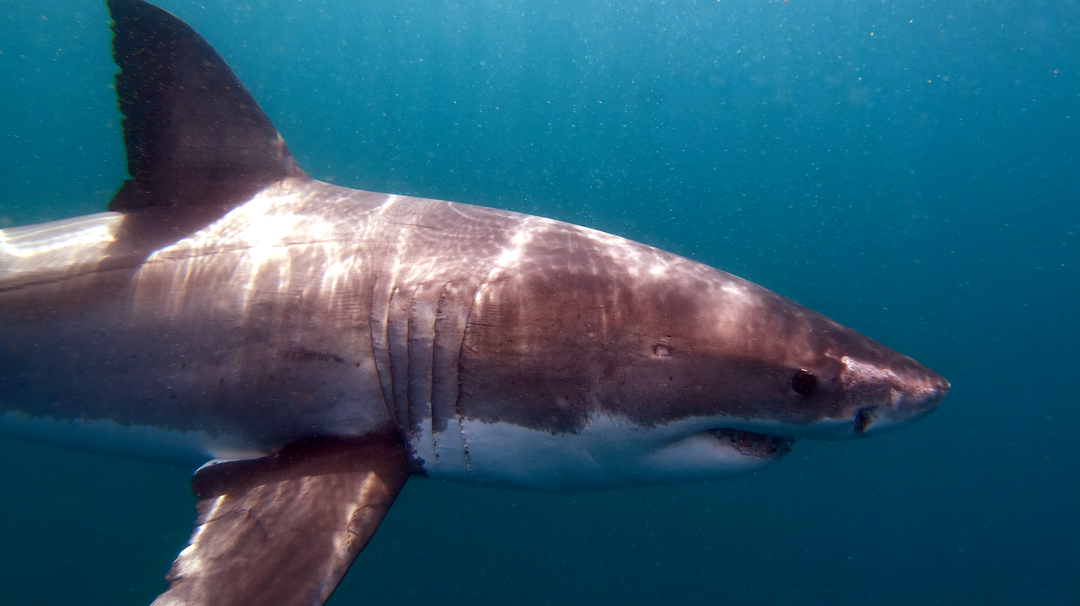
The next time you are in the water at Mossel Bay and a great white shark passes beneath the boat, it is worth considering what that animal may be carrying with it: the fuel for a journey of thousands of miles, stored in an organ we are only now beginning to understand.
White Shark Ocean operates cage diving and surface encounters in Mossel Bay, one of the few remaining locations in South Africa where great white sharks can still be reliably encountered. Book at whitesharkocean.com.
Frequently Asked Questions
How do great white sharks survive without eating during migration?
Great white sharks store massive amounts of energy as lipid — fat and oil — in their livers before undertaking long migrations. The liver can account for up to 28% of a great white's total body weight and, when fully stocked, up to 90% of the liver's mass is lipid. This energy reserve is sufficient to fuel non-stop ocean crossings of thousands of miles without the shark needing to actively hunt. Research published in the Proceedings of the Royal Society B confirmed this by tracking the rate at which migrating sharks lost buoyancy — a direct measure of liver oil depletion — across the entire migratory route.
What is squalene and why is it important to great white sharks?
Squalene (C30H50) is a hydrocarbon that makes up a significant proportion of the oil stored in a great white shark's liver. It serves two critical functions: it is extremely energy-dense, providing the calories needed to fuel long-distance migration, and it is less dense than seawater, giving the shark buoyancy. Because great white sharks have no swim bladder, they rely on squalene-rich liver oil to maintain neutral buoyancy in the water column. As the oil is metabolised during migration, the shark gradually becomes less buoyant.
What is the longest migration ever recorded for a great white shark?
The longest documented great white shark migration belongs to a female nicknamed Nicole, who swam from South Africa to Western Australia and back — a total round trip of more than 12,400 miles (20,000 kilometres). The outbound leg alone, tracked by satellite tag, covered approximately 6,900 miles in 99 days at an average speed of 2.8 miles per hour. She did not stop to feed during the crossing. The journey, completed in 2003–2004, remains the longest migration ever recorded for any shark species.
Why do orcas target great white shark livers?
Orcas like Port and Starboard in South Africa have been documented extracting the livers from great white sharks with remarkable precision, leaving the rest of the carcass uneaten. The reason is caloric density: the liver of a great white shark is packed with hundreds of thousands of calories of squalene-rich lipid oil — far more usable energy than the same weight of muscle tissue. By targeting the liver, the orcas are maximising the energy return from each kill. Their hunting behaviour independently arrived at the same conclusion as the scientific research: the liver is the most valuable part of the animal.
Where do great white sharks go when they migrate?
Great white sharks follow specific migratory routes tied to seasonal prey availability. South African great whites, like Nicole, have been tracked crossing the Indian Ocean to Australia. California great whites undertake annual migrations of 2,500 miles across the Pacific to a convergence zone halfway between Baja California and Hawaii — nicknamed the "White Shark Café" — before returning to coastal feeding grounds. Atlantic great whites, according to OCEARCH research published in 2026, regularly spend their winters in the Gulf of Mexico before returning to summer feeding grounds off the northeast US coast. These routes are consistent year after year, suggesting great whites navigate with a high degree of precision across open ocean.




Leave a comment