


Nicole, Deep Blue and Unama'ki: The Great White Sharks That Changed What We Know
1 July 2026 | White Shark Ocean
For most of the twentieth century, great white sharks were studied almost entirely through what they left behind — catch records, stomach contents, the accounts of fishermen. Individual animals were indistinguishable from one another. We knew the species existed; we knew almost nothing about individual sharks, where they went, how long they lived, or what they did between the moments they surfaced near boats.
The development of satellite tagging changed this. For the first time, scientists could follow individual animals across thousands of miles of open ocean and build a picture of great white shark lives that no net haul or stomach content analysis could ever provide. And three sharks in particular — Nicole, Deep Blue, and Unama'ki — each contributed something that rewrote a piece of what we thought we knew.

Nicole: The Shark Who Crossed an Ocean
On 7 November 2003, researchers tagged a female great white shark at Gansbaai, South Africa. She was approximately 3.8 metres long and was named Nicole, after the actress Nicole Kidman, by the research team led by Ramon Bonfil of the Wildlife Conservation Society. The tag attached to her dorsal fin was a pop-up satellite archival tag — designed to record depth, temperature, and light levels over a set period and then detach and transmit its data to an overhead satellite.
Ninety-nine days later, the tag surfaced. It was off the coast of Western Australia. Nicole had swum 6,900 miles across the Indian Ocean without stopping.
At the time, this was the longest ocean crossing ever documented for any shark species. The speed — an average of roughly 2.8 miles per hour sustained over more than three months — was itself remarkable. But what made the discovery genuinely extraordinary was what happened next. In August 2004, less than nine months after her departure from South Africa, Nicole was photographed back in Gansbaai. She was identified from a distinctive notch in her dorsal fin. She had returned to almost exactly the point she had left from, completing a round trip of more than 12,400 miles — the fastest known transoceanic round-trip migration of any marine animal.
Nicole's journey did two things for shark science. It proved that great white sharks are not territorial animals bounded by a home range — they are genuinely transoceanic, capable of crossing entire ocean basins and returning. And it raised a question about navigation that has still not been fully resolved: how did she find her way back? The most likely explanation, supported by subsequent research, is that she was reading the Earth's magnetic field through her ampullae of Lorenzini — navigating by the planet's own electrical signature across 12,400 miles of open ocean.
Deep Blue: The Largest Ever Filmed
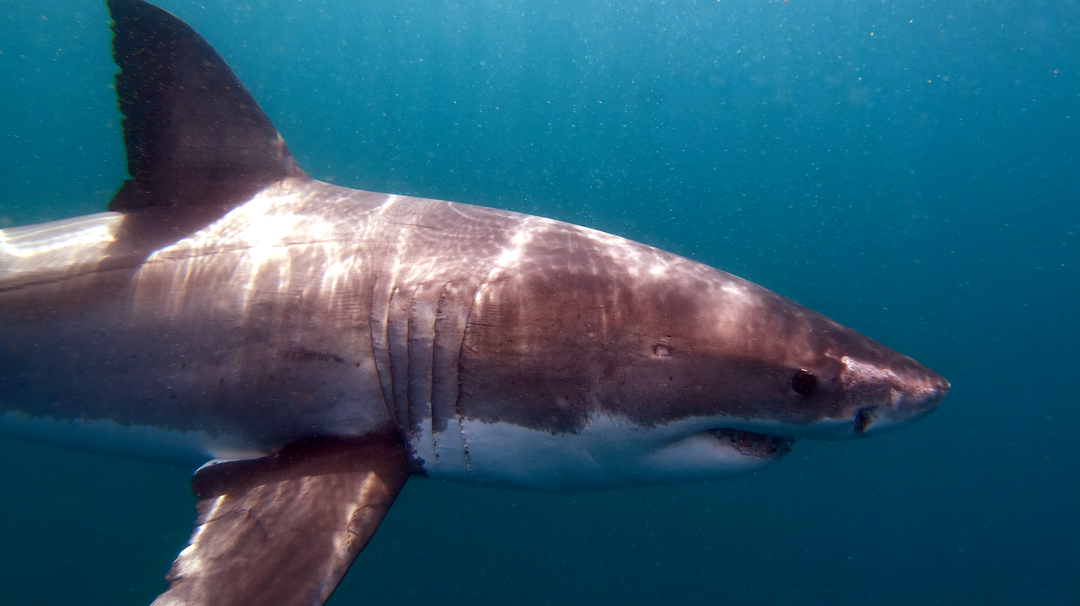
Deep Blue is a female great white shark estimated at approximately 6.1 metres in length — roughly 20 feet — and weighing around 2.5 tonnes. She is believed to be one of the largest great white sharks ever reliably measured, and she is almost certainly the largest ever captured on film.
She was first identified at Isla Guadalupe, a volcanic island off the coast of Baja California in Mexico, where great white sharks congregate each autumn to feed on the island's large northern elephant seal population. Guadalupe is one of the best-studied great white aggregation sites in the world, and the clarity of its deep blue water — which gives the shark her name — makes underwater observation possible in ways that are rare at other sites. Researcher Mauricio Hoyos Padilla first documented Deep Blue there in 1999; she was filmed in detail in 2013 and went viral globally when Discovery Channel broadcast the footage during Shark Week 2015.
In January 2019, Deep Blue reappeared — this time off the coast of Hawaii, feeding on the carcass of a sperm whale that had washed up near Oahu. Marine biologist Ocean Ramsey entered the water alongside her for a close-range encounter that produced some of the most widely shared underwater shark footage ever taken. Deep Blue was visibly larger than she had been in Mexico, with a markedly distended abdomen that led many researchers to speculate she was pregnant.
If current age estimates are correct, Deep Blue is somewhere around 50 years old — placing her birth in the mid-1970s, in an ocean where great white sharks were still being killed for sport and targeted by commercial fisheries with no restrictions. That she survived to this size and age is itself a conservation story. Great white sharks are now believed to live up to 70 years or more, and Deep Blue, at her estimated age, is not even the oldest. She is simply the most visible.
Unama'ki: The Shark That Found a New Ocean
On 20 September 2019, OCEARCH researchers tagged a female great white shark near Scaterie Island, off Cape Breton, Nova Scotia. They named her Unama'ki — the Mi'kmaq First Nations name for Cape Breton, meaning "land of the fog." She was 15 feet 5 inches long and weighed just over 2,000 pounds, making her one of the largest sharks OCEARCH had ever tagged in the northwest Atlantic.
What followed over the next several months became one of the most closely followed tracking stories in OCEARCH's history. Unama'ki left Nova Scotia and moved steadily south along the US east coast, her satellite tag reporting her position every time she surfaced. By Halloween 2019 — 40 days after tagging and roughly 2,000 miles of travel — she had entered the Gulf of Mexico. By February 2020, she was detected near New Orleans.
The Gulf of Mexico detour was not unprecedented, but the depth of penetration was. Unama'ki moved further west into the Gulf than almost any previously tracked great white, at one point being detected well west of the Mississippi River delta. The OCEARCH tracker was updating her position in near-real time, and the public interest was extraordinary — hundreds of thousands of people following a single shark on her winter migration as though tracking a traveller on a long journey.
After the Gulf, Unama'ki turned east and then northeast, passing through the Straits of Florida and out into the open Atlantic. She was tracked near Bermuda before eventually moving into deep open ocean and beyond consistent tag range. OCEARCH researchers noted her open-ocean detour — so far from any known prey population — as a possible indicator of pregnancy. If she was gestating pups, venturing away from coastal areas to give birth in the open ocean would be consistent with great white behaviour near pupping. Her eventual destination, if she was indeed pregnant, could have revealed the location of an unknown Atlantic nursery.
Unama'ki's journey added a specific, individual face to the OCEARCH data that had been accumulating for years. The 2026 study confirming that more than half of tagged Atlantic great whites winter in the Gulf of Mexico was built on data that animals like Unama'ki helped generate. Her track helped shift the Gulf of Mexico from an anomaly to a pattern.
What These Three Sharks Represent
Nicole, Deep Blue, and Unama'ki are not representative of all great white sharks — they are exceptional animals whose circumstances made them visible in ways that most great whites are not. Nicole's tag happened to work precisely and her dorsal fin happened to be identifiable. Deep Blue happens to visit one of the clearest, most-dived aggregation sites in the world. Unama'ki was tagged at the right time by a team with the technology to follow her.
But what they collectively represent is a shift in how science understands the species. Before individual tracking, great white sharks were essentially anonymous — data points in catch records, periodic threats at specific beaches. The tagged individuals turned the species into something that public audiences could follow, care about, and advocate for.
Nicole demonstrated that great whites are ocean-basin animals, not coastal residents. Deep Blue demonstrated that they can live to extraordinary ages, and that individual animals can be known across decades. Unama'ki demonstrated that their seasonal movements are more predictable and more expansive than anyone had realised, and that every individual migration potentially holds information about the species' most closely guarded secrets — including where they give birth.
There are thousands of great white sharks in the world's oceans that no one has ever tagged, named, or followed. Each one is making its own version of these journeys.
Every encounter in Mossel Bay with an untagged, unnamed great white shark is an encounter with an animal whose story we may never fully know. Book with White Shark Ocean at whitesharkocean.com.
Frequently Asked Questions
Who is Nicole the great white shark?
Nicole is a female great white shark tagged off Gansbaai, South Africa, in November 2003 by researcher Ramon Bonfil and the Wildlife Conservation Society. Named after actress Nicole Kidman, she completed the longest ocean migration ever recorded for a shark — swimming 6,900 miles across the Indian Ocean to Western Australia in 99 days, then returning to South Africa within nine months, for a total round trip of over 12,400 miles. She was re-identified on return by a distinctive notch in her dorsal fin. Her journey proved that great white sharks are genuine transoceanic migrants and raised significant questions about their navigational capabilities.
How big is Deep Blue the great white shark?
Deep Blue is estimated at approximately 6.1 metres (20 feet) in length and around 2.5 tonnes in weight, making her one of the largest great white sharks ever reliably documented and the largest ever filmed. She was first identified at Isla Guadalupe, Mexico, in 1999 and filmed in detail in 2013. She resurfaced off Hawaii in 2019, feeding on a sperm whale carcass, and appeared visibly larger than in previous footage — possibly due to pregnancy. Current age estimates put her at around 50 years old, consistent with revised longevity research showing great whites can live 70 years or more.
Who is Unama'ki and why is she significant?
Unama'ki is a female great white shark tagged by OCEARCH researchers near Cape Breton, Nova Scotia, in September 2019. Measuring 15 feet 5 inches and weighing over 2,000 pounds, she is one of the largest great whites ever tagged in the northwest Atlantic. Her name comes from the Mi'kmaq First Nations word for Cape Breton, meaning "land of the fog." Her migration — tracked in near-real time on OCEARCH's public tracker — took her from Nova Scotia to the Gulf of Mexico and further west than almost any previously tracked great white, contributing to the body of data that established the Gulf as a regular winter destination for Atlantic great whites.
How do scientists track individual great white sharks?
Great white sharks are primarily tracked using two technologies: pop-up satellite archival tags, which record depth, temperature, and light data over a set period before detaching and transmitting to a satellite; and acoustic tags, which emit a unique signal detected by underwater receivers placed at monitoring stations around the world. OCEARCH also uses a large research vessel to catch, tag, and release sharks, attaching both acoustic tags and satellite transmitters that report positions each time the shark's dorsal fin surfaces. The public OCEARCH tracker makes some of this data available in near-real time, allowing individual sharks to be followed by general audiences.
Are there other famous individual great white sharks?
Several other individual great white sharks have become well-known through tagging programmes. Ironbound, a large male tagged off Nova Scotia, is estimated to be over 40 years old and is one of the longest-studied individuals in the northwest Atlantic. Lydia, tagged off Jacksonville, Florida in 2013, became the first great white tracked crossing the mid-Atlantic, reaching waters off the coast of Portugal. Each of these individuals has contributed specific data points — migration routes, depth profiles, seasonal timing — that would have been impossible to gather without long-term individual tracking.




Leave a comment