


Smarter Than You Think: The Secret Social Lives of Great White Sharks
24 June 2026 | White Shark Ocean
For most of the twentieth century, the great white shark was understood through a single lens: the perfect killing machine. Solitary. Instinct-driven. Mindless. A torpedo with teeth.
That picture is being dismantled, piece by piece, by a growing body of research that reveals something far more interesting. Great white sharks have social lives. They form bonds. They learn from each other. They have individual personalities. And the more closely scientists look, the more complex the picture becomes.

The Study That Changed the Conversation
In 2022, researchers from Florida International University published a study that quietly rewrote what we thought we knew about great white shark sociality. Working at Guadalupe Island off the coast of Baja California — one of the most intensively studied great white habitats in the world — they tagged six individual sharks with cameras and telemetry receivers that tracked swimming speed, depth, direction, and proximity to other tagged individuals.
What they found was striking. Far from the lone predator of popular imagination, the sharks formed consistent social groupings. During the 2017 and 2018 seasons, they gathered in tight same-sex cliques — male sharks preferring the company of other males, females pairing with females — and sometimes spent more than an hour swimming together in coordinated patterns.
The researchers' interpretation was compelling: the sharks appeared to be "eavesdropping" on each other. By staying in close proximity to other individuals, a shark could gather information rapidly — picking up on behavioural cues that might signal a prey item had been located, a seal had been killed at depth, or a feeding opportunity was nearby. Social proximity, in other words, may function as an information network.
A Language of Fins and Bodies
Alongside the sociality research, ethologists studying great white behaviour have catalogued at least 20 distinct body language behaviours used by white sharks when interacting with each other. These are not random movements. They appear to be a structured communication system, used to establish dominance, signal submission, assess competitors, and avoid conflict.
Common interactions include parallel swimming — where two sharks cruise side by side, presumably assessing each other's size — and circular patterns where individuals examine each other at close range. More assertive encounters involve open-mouthed gaping, pectoral fin depression, and, in some cases, direct body contact.
The common thread running through all of this is hierarchy. Among white sharks, social rank appears to be determined by a combination of size, sex and age. Larger individuals tend to dominate feeding opportunities. Females, which grow larger than males on average, typically outrank males of similar age. And critically, these hierarchies appear to be largely respected: the body language system exists precisely to establish rank without the cost and risk of direct conflict.
"Great white sharks are surprisingly intelligent creatures," shark expert Leonard Compagno, who spent more than 20 years studying white sharks in South Africa, has noted. "They engage in complex social behaviour and display intelligence even when the situation doesn't obviously demand it."
Pair Hunting: Cooperation at the Top of the Food Chain
Perhaps the most surprising finding of recent years is that great white sharks occasionally hunt cooperatively. Research published in The Conversation documented instances of pair hunting at Seal Island in False Bay — the same waters that have featured so prominently in recent stories about South Africa's shark decline. In these observations, two individuals appeared to coordinate their approach to prey, with one driving the target towards the other.
Whether this represents genuine intentional cooperation or simply parallel predatory behaviour that happens to benefit both sharks remains debated. But the fact that it occurs at all is significant. It suggests that white sharks are capable of adjusting their behaviour in response to the presence and movements of other individuals — a level of social awareness that goes far beyond what the "mindless killer" narrative implies.
The Mossel Bay Data Point
Not all research points in the same direction. A 2016 study of white sharks around Mossel Bay, South Africa, concluded that associations there were generally more random, with fewer consistent social groupings than those observed at Guadalupe Island. This discrepancy is itself scientifically interesting — it suggests that social behaviour in great whites may be context-dependent, shaped by local prey availability, population density, and habitat characteristics.
Guadalupe Island, with its dense aggregations of California sea lions and large numbers of white sharks converging on a relatively contained area, may simply create stronger incentives for social information-sharing than the more dispersed hunting grounds around Mossel Bay. The social behaviours may be present in both populations — just expressed differently depending on the ecological context.
Learning Across Generations
The intelligence question extends beyond social interaction. Great white sharks are capable of associative learning — modifying their behaviour based on past experience in ways that persist over time. Individual sharks studied at sites like Guadalupe Island and False Bay show consistent personality traits across multiple visits spanning years: some are bold and investigative, others cautious and peripheral. These individual differences cannot be explained by simple instinct.
More striking still is the growing evidence for social learning — the transmission of learned behaviours from one individual to another. The most dramatic example remains Port and Starboard, the South African orcas who appear to be teaching other individuals their technique for extracting great white shark livers. But a 2025 study from the Gulf of California documented something similar in the prey: white sharks in an area where orca predation had recently occurred rapidly learned and shared a flight response, abandoning habitats they had used for years within days of a predation event. The knowledge that a place had become dangerous spread through the local white shark population with striking speed.
What This Means for How We See Them
The "mindless killing machine" narrative was never just a factual error — it was a cultural frame that made it easier to fear sharks, harder to care about them, and simpler to justify their persecution. Understanding great white sharks as socially complex, individually distinct, learning animals changes that frame fundamentally.
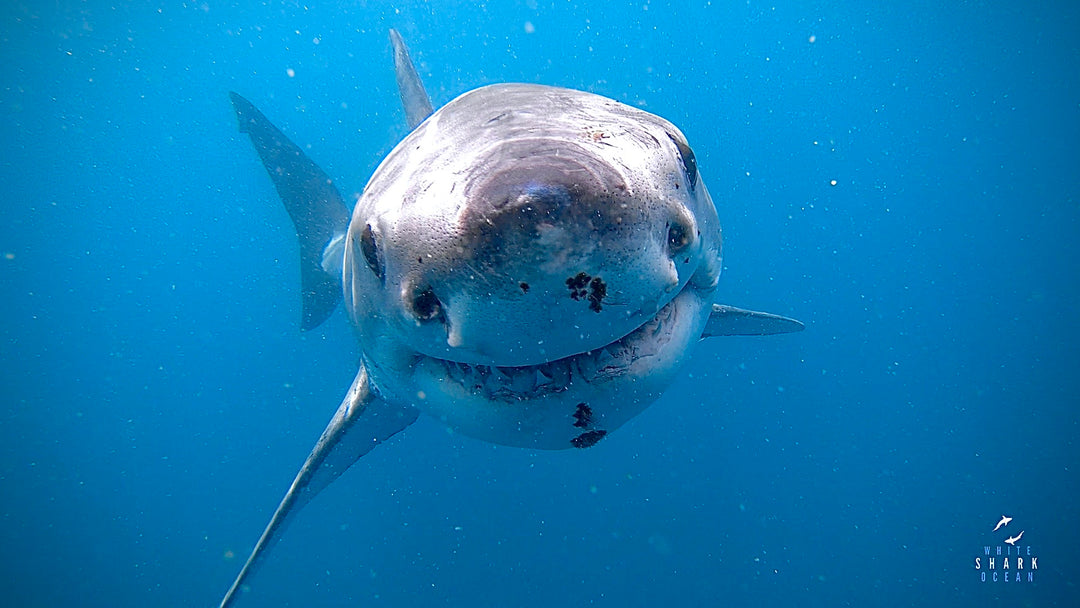
When you watch a great white shark from a cage in Mossel Bay, you are not watching an automaton following ancient programming. You are watching an animal that knows its place in a social hierarchy, that has a history of relationships with other individuals in its range, that may well have learned behaviours from its contemporaries, and that is actively assessing you — curious, cautious, intelligent — just as you are assessing it.
That encounter deserves more than fear. It deserves respect.
Ready to see great white sharks up close in their natural habitat? White Shark Ocean operates cage diving and surface viewing expeditions in Mossel Bay, South Africa. Book at whitesharkocean.com.
Frequently Asked Questions
Are great white sharks intelligent?
Yes — great white sharks are now understood to be significantly more intelligent than popular culture suggests. Research has documented associative learning (modifying behaviour based on past experience), social learning (acquiring behaviours from other individuals), individual personality differences, and strategic information-sharing. Shark expert Leonard Compagno, who spent more than 20 years studying white sharks in South Africa, describes them as "surprisingly intelligent creatures" capable of complex social behaviour.
Do great white sharks live in groups?
Great white sharks are not social in the way dolphins or orcas are, but they are not entirely solitary either. Research at Guadalupe Island documented consistent same-sex social groupings, with individual sharks spending extended periods swimming together and apparently sharing information about prey locations. Social behaviour appears to be context-dependent — more pronounced at sites with high shark density and abundant prey, less so in areas like Mossel Bay where sharks are more dispersed.
How do great white sharks communicate?
Great white sharks communicate primarily through body language. Researchers have catalogued at least 20 distinct behavioural signals used during inter-shark interactions, including parallel swimming, circular assessment patterns, pectoral fin depression, open-mouthed gaping, and direct physical contact. These signals appear to function as a structured social communication system, used mainly to establish and maintain dominance hierarchies without the cost of direct conflict.
Do great white sharks hunt in pairs?
There are documented instances of great white sharks hunting cooperatively in pairs, including observations at Seal Island in False Bay, South Africa. Whether this represents genuine intentional cooperation or parallel behaviour that coincidentally benefits both individuals is still debated among researchers. Either way, it demonstrates that white sharks are capable of adjusting their behaviour in response to the presence and actions of other individuals — a degree of social awareness beyond simple instinct.
Can great white sharks learn from each other?
Evidence strongly suggests yes. The most compelling examples come from flight response studies: when orcas began predating on great white sharks in specific areas, the flight behaviour of surviving sharks spread rapidly through the local population, suggesting social transmission of learned information. Individual sharks at well-studied sites also show consistent personality traits across multiple visits spanning years, and the overall picture from current research is of animals capable of both individual learning and socially acquired behaviour.







Leave a comment