



How Great White Sharks See the World
16 July 2026 | White Shark Ocean
The moment a great white shark commits to a strike, something strange happens. The eyes, which have been tracking the prey through the final approach, rotate backward into the skull. The shark hits its target blind. It is a decision that looks, on the surface, like a design flaw — until you understand what those eyes were doing for the rest of the hunt, and why, at the critical instant, something else takes over.
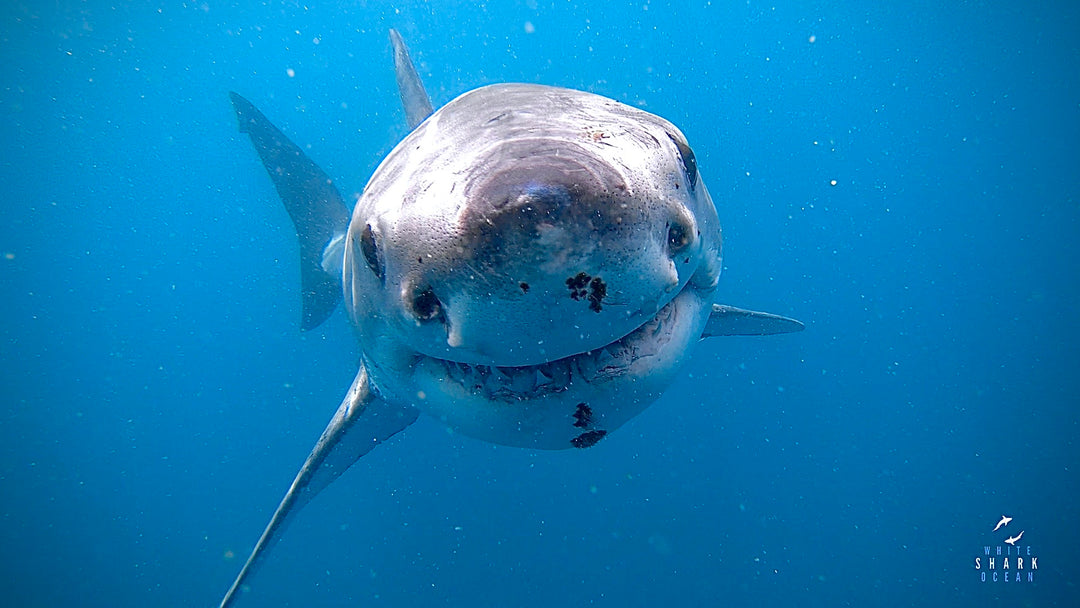
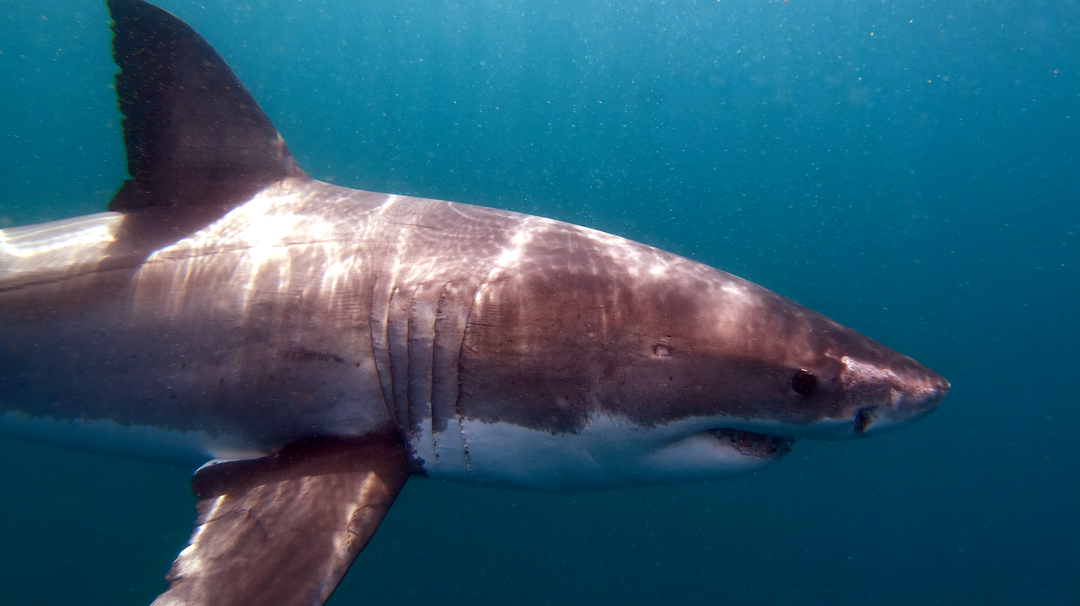
Great white shark vision is one of the most precisely engineered sensory systems in the ocean. Understanding it means understanding not just how sharks see, but how they integrate sight with their other senses to build a complete picture of the underwater world — and where in that picture they have made deliberate evolutionary trade-offs.

Built for Low Light
The great white eye is structured for one primary challenge: detecting prey in the dim, contrast-poor conditions of open water. The retina is dominated by rod cells rather than cone cells. Rod cells are the photoreceptors responsible for low-light sensitivity and motion detection. Cone cells, which are responsible for colour discrimination and fine detail in bright light, are present but sparse. The practical implication is that a great white shark sees the underwater world largely in terms of contrast, movement, and silhouette rather than fine colour detail — but it sees these things extraordinarily well even in low light.
The reason for this low-light capability is a structure behind the retina called the tapetum lucidum — the same structure that makes cats' eyes reflect in the dark. The tapetum lucidum is a mirror-like layer of highly reflective cells that bounces incoming light back through the retina a second time, effectively doubling the amount of light the photoreceptors can process. In great white sharks, this structure amplifies available light by a factor of approximately ten, giving them the ability to detect movement and contrast in conditions where their prey essentially cannot see at all.
This is why great white sharks are most active as hunters at dawn and dusk — the crepuscular periods when light levels are dropping below the threshold at which most prey animals can see effectively, but still above the threshold at which the great white's rod-heavy, tapetum-amplified visual system is operating at its best. The overlap between diminishing prey visibility and peak shark visual performance is not coincidental. It is the result of 450 million years of selection pressure on a hunting strategy built around that exact window.
What Colour Can They See?
The cone cells present in the great white retina are tuned primarily to the blue-green wavelengths that penetrate deepest into ocean water. This makes functional sense: in the open ocean, the colours that remain visible at depth are blues and greens, because water absorbs longer wavelengths (reds, oranges, yellows) rapidly. A visual system tuned to these wavelengths is optimised for the environment rather than for broad colour discrimination.
Evidence suggests that great white sharks are likely monochromatic or near-monochromatic — that is, they probably do not distinguish colours the way humans do, but rather perceive the world in varying intensities of blue-green light, combined with the contrast and motion information coming from their rod-cell majority. What looks to a human like a richly coloured underwater scene is, for a great white, most likely a world of moving shapes, edges, and contrasts against a background of filtered blue light.
This has practical implications for how sharks interact with objects in the water. High-contrast items — particularly anything that creates a strong boundary between light and dark, or that mimics the silhouette of a seal or fish against the surface — are far more visually salient to a great white than colour differences. The pattern of a wetsuit matters less than its contrast against the water. A splashing object in low light matters more than a stationary, brightly coloured one in daylight.
The Eye Roll
Most sharks possess a nictitating membrane — a protective third eyelid that can be drawn across the eye during an attack. Great white sharks do not. Instead, they have evolved a more complete solution: when threatened or when a strike becomes imminent, the entire eyeball rotates backward into the socket, leaving only the whites of the eye visible. The eye is protected not by a membrane but by the orbital socket itself, as the eyeball physically retreats behind the protective cartilage of the skull.
The eye roll is a behaviour many people find unsettling when they see it for the first time, but the logic behind it is straightforward. The final moments of an attack on a large, struggling prey animal are the most dangerous for the shark's eyes. A seal fighting back can cause serious damage with its flippers, and the thrashing of a large fish can be unpredictable. Rolling the eyes back removes them from danger entirely during the period of maximum risk.
But there is a second reason the eye roll is possible at all: by the time the jaws are closing on prey, the shark no longer needs its eyes to complete the attack. The final approach to within striking distance is guided by the lateral line system, which detects pressure waves in the water, and by the ampullae of Lorenzini, the electroreceptive organs clustered around the snout that can detect the electrical field generated by the prey's muscles and nervous system. These systems provide a precise, real-time map of where the prey is and how it is moving, independent of light and independent of vision. The eyes can be safely withdrawn precisely because something more accurate has taken over.
Pupil Control and Surface Vision
The great white pupil is not fixed — it can dilate and contract across a wide range, allowing the eye to adapt between very bright surface conditions and the dimmer water column below. This flexibility is more significant than it might appear. Great whites frequently hunt from below, approaching prey at the surface from deeper water where light levels are lower. The visual system needs to function across a wide dynamic range: bright, high-contrast surface light when looking up toward a seal silhouetted against the sky, and dimmer, diffuse conditions when scanning open water laterally or looking down.
The ability to vary pupil size across this range, combined with the tapetum lucidum's light amplification, means the great white can shift fluidly between these different visual conditions as it approaches prey from depth. The counterlit silhouette of a seal against a bright sky is one of the most visually salient stimuli a great white encounters, which is why the characteristic breach attack — launched vertically from below at high speed — is so precisely targeted. The shark has been tracking the silhouette from a distance with a visual system specifically designed to see it.
Vision in Context
It is tempting to think of great white shark vision in isolation, but the eyes are one component of a sensory array that also includes electroreception, mechanoreception via the lateral line, olfaction, and hearing. In the early stages of detecting and locating prey, smell and hearing are often the initiating senses — great whites can detect low-frequency sound vibrations from considerable distances and can smell blood at concentrations of one part per ten billion. As they approach, vision becomes increasingly important for tracking and targeting. In the final moments, electroreception takes precedence.
The eye roll is the clearest expression of this sensory handover: vision is literally switched off at the moment electroreception provides all the information the shark needs. Each sense has its optimal range and conditions; the great white moves through them sequentially during an approach, like a pilot transitioning from instruments to visual to manual as the approach to landing progresses.
What this means for how great whites experience the world is that their visual reality is probably not the primary dimension of their sensory experience. The ocean, to a great white shark, is first and foremost an acoustic and olfactory space. Vision sharpens the picture as prey comes into range. And then, at the last instant, it steps aside entirely.
White Shark Ocean operates cage diving and surface encounters in Mossel Bay, South Africa. Observe great white shark behaviour — including the eye roll — safely and up close. Book at whitesharkocean.com.
Frequently Asked Questions
Can great white sharks see well?
Yes, particularly in low-light conditions. Great white shark eyes are dominated by rod cells rather than cone cells, making them highly sensitive to light, contrast, and movement but less suited for fine colour discrimination. A mirror-like layer behind the retina called the tapetum lucidum reflects incoming light back through the retina a second time, amplifying available light by approximately ten times. This makes great whites effective visual hunters in conditions where their prey can barely see, which is why they are most active at dawn and dusk.
Can great white sharks see colour?
Probably not in the way humans do. The cone cells present in the great white retina are tuned primarily to blue-green wavelengths — the colours that penetrate deepest into ocean water — and evidence suggests sharks are likely monochromatic or near-monochromatic. Rather than distinguishing between colours, they perceive the underwater world primarily in terms of contrast, movement, and light intensity. High-contrast objects, particularly those that create a strong silhouette against the surface, are far more visually salient to a great white than colour differences.
Why do great white sharks roll their eyes back?
Great white sharks do not have a nictitating membrane (a protective third eyelid) as most other sharks do. Instead, when a strike becomes imminent or when the eyes are at risk, the entire eyeball rotates backward into the socket, protected by the cartilage of the skull. This happens during the final moments of an attack when the eyes are most vulnerable to injury from struggling prey. By this point, the shark no longer needs its vision to complete the attack — the electroreceptive ampullae of Lorenzini have taken over, providing a precise map of the prey's position independent of light.
What is the tapetum lucidum in sharks?
The tapetum lucidum is a reflective layer of cells located behind the retina, found in great white sharks and many other animals that need to see well in low light, including cats and dogs. It works by reflecting light that has already passed through the retina back through the photoreceptors a second time, effectively doubling the amount of light available to the eye. In great white sharks, this amplifies available light by approximately ten times and is the primary reason they are such effective visual hunters in low-light conditions at dawn, dusk, and at depth.
When are great white sharks most active?
Great white sharks are most active as hunters during crepuscular periods — dawn and dusk. This timing is driven by their visual system: the tapetum lucidum and rod-cell dominated retina give them excellent low-light vision, while their prey's visual systems are less effective in these transitional light conditions. This creates a window where the great white's visual capabilities significantly outperform those of the animals it is hunting. Attacks on seals at the Farallon Islands and in South African waters are most frequently recorded in the early morning and late afternoon, consistent with this crepuscular hunting pattern.







Leave a comment